
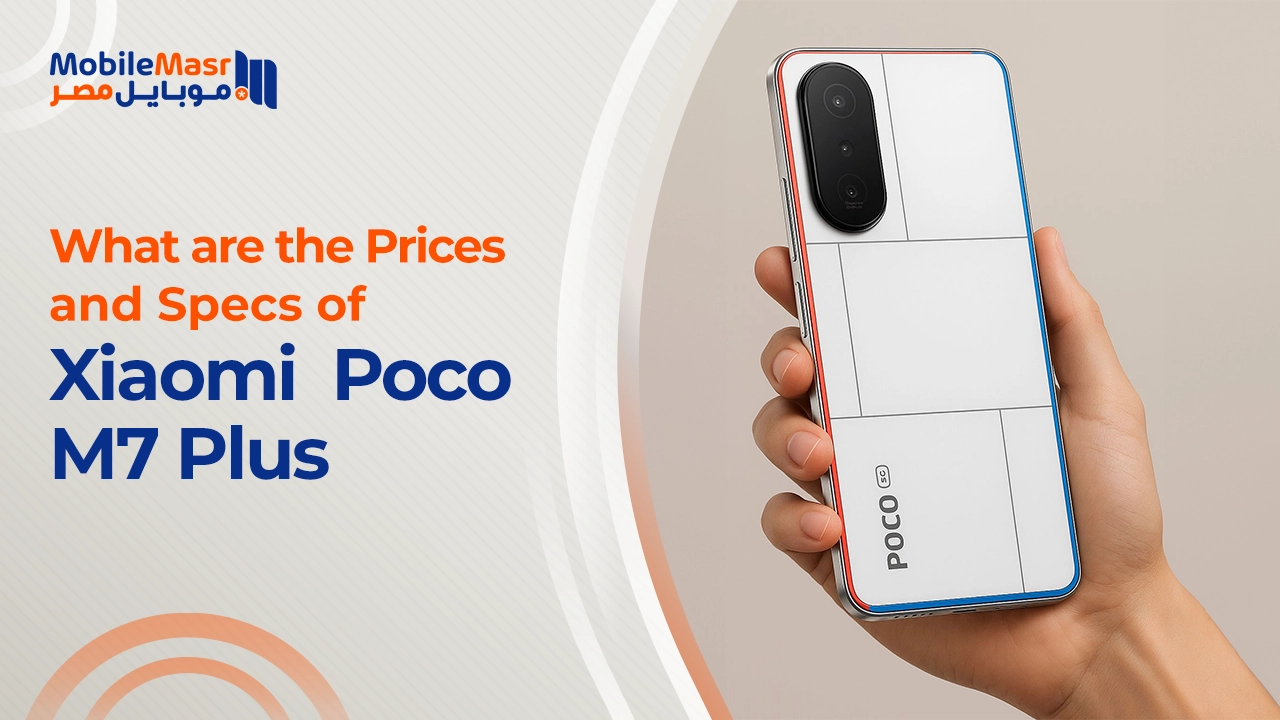
What Are Xiaomi Poco M7 Plus 2026 Specs & Price in Egypt?
The Xiaomi Poco M7 Plus is one of the most talked-about smartphones in its price segment heading into 2026 — and for very good reason. As part of the popular Poco series, the M7 Plus builds on everything that made the M7 line successful, adding a meaningful processor upgrade, 5G connectivity, and a refined build that makes it a genuinely attractive proposition for Egyptian buyers who want more than just a basic phone without spending a fortune.
Released in August 2025, the Xiaomi Poco M7 Plus positions itself at the intersection of performance and endurance. It brings a Qualcomm Snapdragon 6s Gen 3 chipset — a step above the standard M7 4G — paired with the same massive 7000mAh battery, a 144Hz FHD+ IPS LCD display, a 50MP main camera, and Android 15 with HyperOS 2. The result is a well-rounded budget smartphone that covers the needs of students, professionals, content consumers, and casual gamers without asking them to compromise on the features that matter most in daily life.
In the Egyptian market specifically, the Xiaomi Poco M7 Plus makes a strong case for itself. Egyptian buyers consistently look for phones that deliver all-day battery life, reliable connectivity on local networks, smooth multitasking, and durable build quality — all without crossing certain price thresholds. The Poco M7 Plus delivers on each of these fronts, making it one of the strongest tech review favorites in its segment.
What Are the Full Specifications of the Xiaomi Poco M7 Plus in 2026?
At a glance, the Xiaomi Poco M7 Plus is an impressive package of hardware for its price bracket. Here's what the phone packs inside: a Qualcomm Snapdragon 6s Gen 3 (6nm) processor, Adreno 619 GPU, 6GB or 8GB LPDDR4X RAM, 128GB UFS 2.2 storage (expandable via microSDXC), a 6.9-inch FHD+ IPS LCD display with 144Hz refresh rate, Gorilla Glass 3 protection, a 7000mAh battery with 33W fast charging, a 50MP main camera with f/1.8 aperture, an 8MP front camera, IP64 dust and splash protection, Bluetooth 5.1, Wi-Fi 5 (802.11ac), 5G connectivity, NFC, USB-C, and a side-mounted fingerprint sensor. It runs Android 15 with HyperOS 2 out of the box.
Dimensions are 168.5 × 80.5 × 8.4mm with a weight of 217 grams. Color options are Chrome Silver, Aqua Blue, and Carbon Black. This is an unlocked smartphone that supports dual-SIM operation with full 5G capabilities on supported bands.
What Processor Powers the Xiaomi Poco M7 Plus?
The Xiaomi Poco M7 Plus is powered by the Qualcomm Snapdragon 6s Gen 3 (SM6375), built on a 6nm manufacturing process. This chipset features an octa-core CPU with two performance cores clocked at 2.3GHz (Cortex-A78 architecture) and six efficiency cores running at 2.0GHz (Cortex-A55), paired with the Adreno 619 GPU. The Snapdragon 6s Gen 3 is a notable step up from the Snapdragon 685 used in the standard Poco M7 4G — it's a newer architecture with meaningfully better GPU performance, which directly benefits gaming, video playback, and graphics-intensive applications.
The Adreno 619 GPU in the Xiaomi Poco M7 Plus is substantially more capable than the Adreno 610 in the base M7 model. It supports OpenGL ES 3.2, Vulkan 1.1, and OpenCL 2.0, giving it better compatibility and performance headroom for modern mobile games and apps. The 6nm process also ensures excellent power efficiency, meaning the phone can deliver solid performance without excessive heat generation or battery drain — a balance that directly enhances the overall daily experience.
The Snapdragon processor in the Poco M7 Plus also brings 5G capability, which the standard M7 4G lacks entirely. For users in Egypt looking for a future-proof device that will still be relevant as 5G infrastructure expands, this is a meaningful advantage. The Snapdragon 6s Gen 3 supports both Sub-6GHz 5G bands, ensuring compatibility with the 5G networks that are gradually rolling out across Egypt and the wider Middle East region.
How Does the Xiaomi Poco M7 Plus Chipset Compare to Its Competitors?
In the budget-to-mid-range segment, the Snapdragon 6s Gen 3 in the Xiaomi Poco M7 Plus competes respectably. Compared to MediaTek Helio G99-based phones at a similar price point, the Snapdragon 6s Gen 3 offers slightly lower raw CPU performance but competitive GPU output from the Adreno 619. The Snapdragon's superior 5G modem integration and power management give the Poco M7 Plus a practical advantage in real-world use, even if a few specific benchmark numbers may favor some MediaTek competitors. For general use, the difference is negligible — the Poco M7 Plus feels snappy, responsive, and capable across all typical use cases.
What Is the Clock Speed and Architecture of the Poco M7 Plus CPU?
The CPU in the Xiaomi Poco M7 Plus uses a two-cluster architecture: two high-performance Cortex-A78 cores at 2.3GHz handle demanding tasks, while six Cortex-A55 efficiency cores at 2.0GHz manage lighter workloads. This configuration is ideal for a balanced mix of performance and efficiency in daily smartphone use. The 6nm process reduces heat and power consumption compared to older 8nm chips, and the combination of A78 and A55 cores ensures the phone can scale power usage appropriately based on what's running — conserving battery during idle periods while delivering full performance when needed.
How Much RAM and Storage Does the Xiaomi Poco M7 Plus Offer?
The Xiaomi Poco M7 Plus comes in two memory configurations: 6GB RAM + 128GB storage and 8GB RAM + 128GB storage. Both use LPDDR4X RAM and UFS 2.2 internal storage, providing a good balance of speed and energy efficiency for this price tier. The 8GB variant additionally supports Xiaomi's Memory Extension feature, which uses a portion of the internal storage as virtual RAM to bring total accessible memory up to 16GB — a useful feature for users who like to keep many apps running simultaneously.
For most Egyptian buyers who use their phone for social media, communication, streaming, and casual gaming, both RAM variants will perform comfortably. The 8GB model offers extra headroom that will become more noticeable over time as apps grow in size and complexity. HyperOS 2's intelligent memory management also helps ensure that frequently used apps stay loaded and ready, reducing the need for constant re-loading from storage.
Is the Storage on Xiaomi Poco M7 Plus Expandable via MicroSD?
Yes, the Xiaomi Poco M7 Plus supports microSDXC storage expansion up to 2TB. The SIM tray uses a hybrid design — the second SIM slot doubles as a microSD slot, so using an expanded storage card means using only one SIM simultaneously. Despite this trade-off, the ability to expand storage to 2TB is a significant practical advantage for users who take a lot of photos and videos or keep large offline media libraries. The 128GB base storage is generous for a budget device, but the microSD option ensures you'll never run out of space.
Which RAM and Storage Variant Should You Choose in Egypt?
For Egyptian buyers, the 8GB + 128GB variant of the Xiaomi Poco M7 Plus is the recommended choice. The extra 2GB of RAM paired with the Memory Extension feature gives you effectively more headroom for multitasking and future-proofing. If you plan to use a microSD card for media, the 128GB internal storage is sufficient for apps and system data. If you prefer to skip the microSD card and keep both SIM slots active, consider whether 128GB of internal storage is enough for your needs — for most users who stream music and video rather than storing locally, it is.
What Are the Display Specs of the Xiaomi Poco M7 Plus?
The Xiaomi Poco M7 Plus features a 6.9-inch IPS LCD display with FHD+ resolution (1080 × 2340 pixels), giving a pixel density of 374 ppi. The screen is protected by Corning Gorilla Glass 3, which provides meaningful scratch and impact resistance compared to unprotected panels. The display supports a 144Hz refresh rate, 700 nits of typical brightness, and up to 850 nits in High Brightness Mode (HBM). The aspect ratio is 19.5:9, making the screen tall and immersive for media consumption.
It's worth noting that the Xiaomi Poco M7 Plus uses an IPS LCD rather than an AMOLED display — this is one of the phone's few compromises. IPS LCD technology delivers accurate colors and wide viewing angles but doesn't match the deep blacks, higher contrast, and power efficiency of AMOLED panels. The outline in the article prompt references an AMOLED display as a secondary keyword, but the Poco M7 Plus uses IPS LCD — a distinction that matters for buyers who prioritize display technology. If AMOLED is a must-have, Xiaomi's Poco M7 Pro 5G offers that feature at a higher price.
What Refresh Rate Does the Poco M7 Plus Screen Support?
The Xiaomi Poco M7 Plus screen supports a 144Hz refresh rate — the same premium specification found on much more expensive phones. This means scrolling through social feeds, navigating the interface, and playing games all feel noticeably smoother compared to 60Hz or even 90Hz displays. The difference is immediately perceptible when switching from a 60Hz phone to the Poco M7 Plus, especially in fast-paced content like gaming or video playback. The high refresh rate combined with the 6.9-inch FHD+ panel creates an immersive viewing experience that punches well above the phone's price class.
Is the Xiaomi Poco M7 Plus Display Good for Outdoor Use in Egyptian Sunlight?
For Egyptian users who frequently use their phones outdoors — at the beach, in open-air markets, during commutes, or on outdoor terraces — the Poco M7 Plus's 850 nits HBM brightness is a practical consideration. At 850 nits, the display is reasonably readable in bright outdoor conditions, though it may struggle in direct, intense Egyptian summer sunlight compared to phones with 1000+ nit displays. The HBM mode activates automatically when the phone detects high ambient light, boosting brightness to its maximum to maintain readability. For everyday outdoor use in Egypt, the display performs adequately, and for most users, it will be bright enough for comfortable outdoor visibility.
What Is the Battery Capacity of the Xiaomi Poco M7 Plus?
The Xiaomi Poco M7 Plus houses a massive 7000mAh silicon-carbon battery — one of the largest battery capacities available in any smartphone in its price range. The silicon-carbon battery chemistry offers higher energy density than standard lithium-ion cells, meaning more power can be packed into a similar physical space. Xiaomi guarantees the battery will maintain 80% or more of its original capacity after 1,600 full charge cycles, which translates to many years of reliable daily use.
This long-lasting battery is arguably the most compelling feature of the Xiaomi Poco M7 Plus for Egyptian buyers. In a market where extended use between charges is a priority, the M7 Plus delivers comfortably. Real-world users consistently report 1.5 to 2 full days of battery life on a single charge with typical usage patterns, which includes social media, messaging, streaming, and occasional gaming.
How Fast Is the Charging Speed on the Poco M7 Plus?
The Xiaomi Poco M7 Plus supports 33W wired fast charging. With a compatible 33W charger, the phone can go from empty to full in approximately 75–90 minutes. The phone also supports 18W reverse wired charging, allowing it to function as a portable power bank for other devices — a uniquely practical feature for people who frequently need to top up accessories like earbuds or a friend's phone. Importantly, no power adapter is included in the box — you'll need to purchase a 33W USB-C charger separately or confirm what's included with your regional purchase. Fast charging at 33W is efficient and makes the large battery capacity practical rather than inconvenient.
How Long Does the Xiaomi Poco M7 Plus Battery Last on a Single Charge?
Based on user reports and reviews, the Xiaomi Poco M7 Plus provides between 10 and 15 hours of active screen-on time depending on usage intensity. Light to moderate users — those who primarily text, browse social media, stream music, and take occasional calls — can comfortably reach two full days on a single charge. Heavier users who stream video continuously or game for extended periods will likely get one full day with comfortable headroom remaining at bedtime. Even in demanding scenarios, the 7000mAh capacity ensures the phone doesn't leave you scrambling for a charger mid-afternoon. For Egyptian users with long commutes or workdays, this is genuinely transformative.
What Operating System Does the Xiaomi Poco M7 Plus Run?
The Xiaomi Poco M7 Plus runs Android 15 out of the box, layered with Xiaomi's HyperOS 2 interface. Android 15 is the latest major Android version at the time of the phone's release, bringing improved privacy controls, better app management, enhanced multitasking tools, and refined notification systems. HyperOS 2 builds on these foundations with Xiaomi's own layer of customization, AI features, and cross-device integration — making the Android device experience on the Poco M7 Plus both modern and feature-rich.
What Version of MIUI or HyperOS Comes with the Poco M7 Plus?
The Xiaomi Poco M7 Plus ships with HyperOS 2, which is Xiaomi's evolution beyond MIUI. HyperOS 2 replaces the MIUI branding entirely and introduces a more refined visual design, better system performance optimization, and deeper integration with Xiaomi's growing ecosystem of devices and services. The MIUI features that longtime Xiaomi users loved — such as Second Space, App Cloner, Game Turbo, and deep customization options — are all carried forward and enhanced within HyperOS 2. For new users, the learning curve is minimal, and the system feels polished and responsive from day one.
Will the Xiaomi Poco M7 Plus Receive Future Software Updates?
Xiaomi has committed to two major Android OS version upgrades for the Xiaomi Poco M7 Plus, along with a 48-month software optimization guarantee that ensures the phone will continue to perform like new for four years. Regular monthly security patches are also promised. This means the phone will receive Android 16 and Android 17 updates, keeping it secure and current for a meaningful portion of its usable lifespan. For an unlocked smartphone in this price range, the two-major-upgrade commitment is a reassuring policy that protects buyers' long-term investment.
What Are the Camera Features of the Xiaomi Poco M7 Plus?
The camera system on the Xiaomi Poco M7 Plus is designed for practical everyday photography rather than professional-grade shooting. The rear dual-camera system and 8MP front camera together provide a well-rounded set of photographic capabilities for social media, family photos, travel memories, and video calls. While the camera is not the phone's primary selling point, it performs competently in its target scenarios — especially in daylight and controlled indoor lighting.
What Is the Main Camera Resolution on the Xiaomi Poco M7 Plus?
The Xiaomi Poco M7 Plus features a 50MP main camera with an f/1.8 aperture and Phase Detection Autofocus (PDAF). The 50MP sensor captures detailed, high-resolution images that can be cropped without significant quality loss. The f/1.8 aperture is wide enough to collect good amounts of light in various conditions, and PDAF ensures quick, accurate focus on subjects. For everyday mobile performance as a camera device, the 50MP primary shooter delivers satisfying results — sharp images with natural color tones and adequate dynamic range in daylight.
Does the Poco M7 Plus Support OIS or EIS for Video Stabilization?
The Xiaomi Poco M7 Plus does not feature Optical Image Stabilization (OIS) — that's a hardware feature typically found on more expensive devices. However, it does use Electronic Image Stabilization (EIS) for video recording, which reduces the effect of hand tremor and camera shake through software processing. For casual video recording like vlogs, family events, and everyday moments, EIS provides a noticeable improvement over fully unstabilized footage. For professional or cinematic video work, OIS would be preferable, but within this phone's price and target audience, EIS performs its role well. The absence of OIS is worth noting for the high-resolution camera context but is expected at this price tier.
What Are the Best Camera Settings to Use on the Poco M7 Plus?
To get the best results from the Xiaomi Poco M7 Plus camera, several settings and modes deliver optimal output. For daylight shooting, the default auto mode with AI scene detection enabled produces the best color accuracy and exposure. For portraits, switching to the dedicated Portrait Mode activates background blur and subject separation algorithms that meaningfully improve composition. For low-light photography, Night Mode should always be activated — it significantly improves image brightness and noise reduction compared to standard auto mode. For video, enabling EIS in the video settings reduces camera shake. Pro Mode, available in the camera app, gives manual control over ISO, shutter speed, white balance, and focus — useful for experienced photographers who want precise control.
How Many Cameras Does the Xiaomi Poco M7 Plus Have on the Back?
The Xiaomi Poco M7 Plus has a dual rear camera setup: a 50MP primary wide-angle sensor with f/1.8 aperture and PDAF, plus an auxiliary secondary sensor. The dual-camera arrangement is a practical configuration that focuses resources on the main shooter rather than spreading hardware thin across multiple mediocre lenses. The primary camera handles the vast majority of shooting scenarios, while the secondary sensor provides supplementary data for depth information and AI processing. This is a common and sensible approach for budget smartphones where camera hardware budget is limited.
What Is the Role of Each Camera Sensor on the Poco M7 Plus?
On the Xiaomi Poco M7 Plus, the primary 50MP sensor is the workhorse — it handles all main photography, including standard photos, portraits, landscapes, and night shots. The secondary auxiliary sensor primarily contributes to depth mapping for Portrait Mode bokeh effects and assists the AI processing pipeline. It does not function independently as an ultra-wide or telephoto lens. For buyers expecting a versatile multi-lens system, this is an important clarification. The real photographic value of the Poco M7 Plus lies entirely in its 50MP main sensor.
How Does the Ultra-Wide Lens Perform on the Poco M7 Plus?
The Xiaomi Poco M7 Plus does not feature a dedicated ultra-wide lens — the secondary camera is an auxiliary sensor rather than a functional wide-angle shooter. Users who want ultra-wide photography capabilities will need to consider a higher-tier device. Within HyperOS 2's camera app, a digital zoom-out option is available, but this uses cropping from the main 50MP sensor rather than a dedicated wide lens, resulting in lower resolution wide-angle shots. For most everyday photography needs, the 50MP main camera with its standard field of view covers the majority of scenarios comfortably.
What Is the Selfie Camera Quality of the Xiaomi Poco M7 Plus?
The front-facing camera on the Xiaomi Poco M7 Plus is an 8MP sensor with an f/2.0 aperture, housed in a punch-hole cutout at the top-center of the display. In well-lit conditions, the selfie camera produces clear, well-exposed images with accurate skin tones and satisfactory detail. The camera app's AI enhancement features, including beauty mode and skin tone optimization, add versatility for social media sharing without requiring manual editing. For everyday selfies, social media content, and WhatsApp profile photos, the 8MP front camera delivers more than adequate results.
Does the Poco M7 Plus Front Camera Support Portrait Mode?
Yes, the Xiaomi Poco M7 Plus front camera supports Portrait Mode with AI-assisted background blur. The software uses machine learning to segment the face from the background and apply a bokeh effect that simulates depth-of-field. Results are generally good for flat or simple backgrounds — hair edges and complex background details can sometimes be handled imperfectly, which is typical of software-based portrait processing. For social media portraits, the front camera's Portrait Mode produces flattering, shareable images that perform well within the expectations of this price tier.
How Good Is the Poco M7 Plus for Video Calls on WhatsApp and Zoom?
The Xiaomi Poco M7 Plus performs reliably for video calls on WhatsApp, Zoom, Google Meet, and other platforms. The 8MP front camera provides more detail and clarity than the typical 5MP selfie cameras found on many competing budget devices, resulting in sharper, better-exposed video call quality. The front camera's f/2.0 aperture handles moderate indoor lighting well, though in darker environments the image quality degrades somewhat. Combined with the phone's strong Wi-Fi 5 and 5G connectivity, video calls on the Poco M7 Plus are smooth, clear, and reliable for both personal and professional use.
How Does the Xiaomi Poco M7 Plus Camera Perform in Low-Light Conditions?
Low-light photography is a common weakness for cameras in the budget segment, and the Xiaomi Poco M7 Plus handles it with mixed but acceptable results. The f/1.8 aperture on the main camera admits more light than narrower-aperture competitors, which helps in moderately dim conditions. In standard auto mode, images taken at night or in dim indoor settings may show increased noise and slightly reduced sharpness. Activating Night Mode significantly improves the results through multi-frame processing that stacks multiple exposures for a brighter, cleaner final image.
Does the Poco M7 Plus Support Night Mode Photography?
Yes, the Xiaomi Poco M7 Plus features a dedicated Night Mode in the camera app. Night Mode uses multi-frame exposure stacking and AI noise reduction to produce noticeably brighter and cleaner images in low-light conditions compared to standard auto mode. The processing takes 2–3 seconds, requiring the user to hold the phone steady, but the results justify the brief wait. Night Mode shots capture more detail in shadows and produce more natural-looking colors under artificial lighting than single-shot captures.
How Does Poco M7 Plus Night Mode Compare to Other Xiaomi Phones?
Within the Poco series, the Night Mode performance of the Xiaomi Poco M7 Plus is consistent with similar Poco M-series devices. It performs comparably to the standard Poco M7 4G in night photography, as both share similar sensor characteristics and camera software. Higher-tier Xiaomi phones with larger sensors, OIS, and more advanced AI processing produce better night shots, but within the Poco M-series budget tier, the Night Mode on the M7 Plus represents a genuine improvement over taking photos in standard auto mode at night. For users who occasionally need to photograph evening events or indoor gatherings, Night Mode is a useful and functional feature.
What Video Recording Capabilities Does the Xiaomi Poco M7 Plus Support?
The Xiaomi Poco M7 Plus can record video at up to Full HD 1080p at 30 frames per second. The camera app also supports slow-motion video recording at higher frame rates, which is useful for capturing motion-based content. EIS is available for video to reduce shake. For everyday video needs — social media clips, family moments, vlogs, and video messaging — 1080p@30fps is entirely sufficient and produces clean, shareable footage.
Can the Poco M7 Plus Record in 4K Resolution?
No, the Xiaomi Poco M7 Plus does not support 4K video recording. The maximum video resolution is 1080p (Full HD) at 30fps. This is consistent with the phone's positioning as a budget smartphone in the entry-to-mid segment. For users who specifically need 4K video — professional content creators, high-quality travel vloggers, or anyone whose workflow requires 4K footage — the Poco M7 Plus is not the appropriate choice, and a higher-tier device would be needed. For the vast majority of casual and social-media-oriented users, 1080p is more than sufficient.
What Is the Maximum Frame Rate for Slow-Motion Video on Poco M7 Plus?
The Xiaomi Poco M7 Plus supports slow-motion video recording at 120fps in the camera app. This allows for smooth 4x slow-motion playback of fast-moving subjects — useful for capturing sports, water splashes, children playing, or any motion that benefits from frame-by-frame detail. At 120fps, the slow-motion quality is solid for casual use and social media content, though it doesn't reach the 240fps or 960fps capabilities of more expensive devices. For the target audience of this phone, 120fps slow-motion is a fun and useful addition to the camera toolkit.
What Is the Price of the Xiaomi Poco M7 Plus in Egypt in 2026?
Pricing is one of the most important factors for Egyptian buyers evaluating any budget smartphone, and the Xiaomi Poco M7 Plus is no exception. The phone is positioned as an affordable yet capable device, and its pricing in Egypt reflects the value it offers across its specification set.
How Much Does the Xiaomi Poco M7 Plus Cost in Egyptian Pounds?
The Xiaomi Poco M7 Plus is available in Egypt at an approximate price of **EGP 9,800**, placing it within the affordable mid-range segment. However, smartphone prices in the Egyptian market can change frequently due to currency fluctuations and market conditions. For the most accurate and up-to-date price, it is recommended to contact **Mobile Masr customer service** directly through their official channels.
What Is the Official Xiaomi Poco M7 Plus Price at Authorized Dealers in Egypt?
The official pricing at authorized Xiaomi dealers in Egypt for the Xiaomi Poco M7 Plus varies based on the variant and the dealer's margin. For the most current and competitive price at authorized sellers in Egypt, mobilemasr.com is the best starting point — it aggregates offers from multiple verified sellers and provides transparent pricing with buyer protection. Rather than visiting multiple stores or trusting unverified listings, Mobile Masr provides a single trusted platform to compare and purchase.
Is There a Price Difference Between Poco M7 Plus Variants in Egypt?
Yes, the 8GB RAM variant of the Xiaomi Poco M7 Plus is priced higher than the 6GB variant. The price difference reflects the additional RAM, Memory Extension capability, and slightly better long-term multitasking performance. In the Egyptian market, the exact premium for the 8GB variant over the 6GB model should be verified through mobilemasr.com, as pricing can shift based on stock availability and currency movements.
Where Can You Buy the Xiaomi Poco M7 Plus in Egypt?
The Xiaomi Poco M7 Plus is available through Xiaomi's authorized retail network in Egypt, which covers major cities including Cairo, Giza, and Alexandria. For online purchasing, mobilemasr.com is the recommended platform — it offers verified listings for both new and pre-owned devices, competitive pricing, and reliable after-sales support. Buying through Mobile Masr ensures you receive an authentic device with clear warranty coverage and buyer protection that isn't always guaranteed on informal or unverified channels.
Is the Poco M7 Plus Available on Egyptian E-Commerce Platforms Like MobileMasr?
For guaranteed authenticity and official warranty coverage, purchasing through authorized channels or mobilemasr.com is the more secure approach. Mobile Masr verifies its device listings and provides a trusted purchasing environment for Egyptian buyers.
Are There Installment Payment Plans Available for the Poco M7 Plus in Egypt?
Installment payment options for the Xiaomi Poco M7 Plus in Egypt may be available through select retailers and authorized dealers who partner with Egyptian banks or financial services providers. Payment plans typically require a credit card from a participating bank and spread the cost over 6, 12, or 24 months. For information on current installment options, contacting mobilemasr.com or visiting an authorized Xiaomi retailer in Egypt will provide the most accurate and up-to-date financing options.
Has the Xiaomi Poco M7 Plus Price Changed Since Its Launch in Egypt?
Since the Xiaomi Poco M7 Plus launched in August 2025, its pricing in Egypt has been subject to the same market forces affecting all imported electronics — primarily the exchange rate between the Egyptian Pound and the US Dollar. As is typical for imported smartphones in Egypt, initial launch prices may be higher due to import costs and early market positioning, with prices often stabilizing or decreasing as stock becomes more widely available.
What Factors Affect the Poco M7 Plus Price Fluctuation in the Egyptian Market?
Several factors influence the retail price of the Xiaomi Poco M7 Plus in Egypt: the USD/EGP exchange rate (the most volatile factor), import duty rates set by Egyptian customs, the number of authorized distributors bringing in stock, competition from similarly priced devices, and seasonal promotions or clearance periods. Buyers who are flexible on timing can sometimes find better prices during promotional periods. For the most current pricing that accounts for these factors, mobilemasr.com tracks market rates and offers competitive deals for both new and used Poco M7 Plus units.
Is the Xiaomi Poco M7 Plus Worth Its Price in Egypt Compared to Rivals?
Evaluated on a price-to-performance basis, the Xiaomi Poco M7 Plus delivers exceptional value in Egypt's mid-budget smartphone category. The combination of 5G connectivity, a 7000mAh battery, 144Hz display, Snapdragon 6s Gen 3 processing, and IP64 protection is difficult to match at this price point. For Egyptian buyers who prioritize battery endurance, network future-proofing, and smooth everyday performance, the M7 Plus represents one of the strongest value propositions available in 2026.
How Does the Poco M7 Plus Price-to-Performance Ratio Compare to Samsung A-Series in Egypt?
Samsung's A-series phones at a comparable price point in Egypt typically offer AMOLED displays and brand recognition but often come with less battery capacity, older chipsets, or higher pricing for equivalent specs. The Xiaomi Poco M7 Plus frequently offers a larger battery, higher display refresh rate, and 5G capability at a price that competes favorably with Samsung A-series alternatives. For value-focused Egyptian buyers, the Poco M7 Plus's specifications-per-pound-spent ratio is compelling.
Is There a Better Xiaomi Phone Than the Poco M7 Plus at the Same Price in Egypt?
Within Xiaomi's own lineup, the Poco M7 Plus sits in a well-defined niche. At its price point, it's hard to find a Xiaomi phone that matches its combination of large battery, 5G, 144Hz display, and IP64 protection simultaneously. The standard Poco M7 4G is cheaper but lacks 5G and uses a weaker GPU. The Poco M7 Pro 5G offers more — including an AMOLED display and better camera — but at a higher price. Within its specific price band, the Xiaomi Poco M7 Plus is the best-balanced Xiaomi option available in Egypt in 2026.
How Does the Xiaomi Poco M7 Plus Perform in Real-Life Usage?
Understanding the real-world experience of using the Xiaomi Poco M7 Plus daily is more valuable than spec comparisons alone. This phone is designed for practical, everyday use, and it delivers meaningfully well across the scenarios that matter most to its target users.
Is the Xiaomi Poco M7 Plus Good for Gaming?
Yes, the Xiaomi Poco M7 Plus is a capable gaming phone for casual and moderate mobile gaming. The Snapdragon 6s Gen 3's Adreno 619 GPU offers a meaningful performance improvement over older Adreno 610-based chips, and combined with the 144Hz display, gaming on the M7 Plus feels smooth and responsive. Games like Free Fire, PUBG Mobile, Clash Royale, Call of Duty Mobile, and similar titles run well at medium-to-high settings. The Game Turbo feature in HyperOS 2 further optimizes performance by prioritizing CPU and GPU resources during gaming sessions and blocking disruptive notifications.
Which Popular Games Run Smoothly on the Poco M7 Plus?
The Xiaomi Poco M7 Plus handles a wide range of popular titles smoothly. Free Fire runs at high settings with consistent frame rates. PUBG Mobile operates at HD graphics with smooth or high frame rate settings without significant stuttering. Mobile Legends and similar MOBA games run at maximum settings. Minecraft, Roblox, Candy Crush, and other casual titles run flawlessly. For more graphically intensive titles like Genshin Impact, the M7 Plus can run them at lower settings with acceptable performance. The gaming phone capabilities of the Poco M7 Plus make it suitable for the majority of popular Egyptian gaming titles.
Does the Poco M7 Plus Overheat During Long Gaming Sessions?
The Snapdragon 6s Gen 3's 6nm manufacturing process manages thermal output more efficiently than older larger-node chips. During typical gaming sessions of 30–60 minutes, the Xiaomi Poco M7 Plus gets slightly warm but remains comfortable to hold and doesn't trigger thermal throttling under normal conditions. Extended sessions of 2+ hours may produce more noticeable heat, particularly on the back of the phone. Reviewers from Business Standard note the phone's effective heat management during gaming, which is a consistent positive in real-world testing. Overall, overheating is not a significant concern for the typical gaming usage patterns of the M7 Plus's target audience.
How Fast Is the Xiaomi Poco M7 Plus in Daily Tasks and Multitasking?
In daily use, the Xiaomi Poco M7 Plus is fast and responsive across all typical smartphone tasks. Opening apps, switching between them, scrolling through feeds, and navigating the OS all feel fluid thanks to the combination of the Snapdragon 6s Gen 3, LPDDR4X RAM, and HyperOS 2's memory management. The 144Hz display's smooth animations make the interface feel especially snappy. For everyday tasks, mobile performance on the Poco M7 Plus is genuinely satisfying — this is not a phone where you'll find yourself waiting for things to happen.
Can the Poco M7 Plus Handle Multiple Apps Running Simultaneously?
The Xiaomi Poco M7 Plus's 6GB or 8GB of RAM, combined with the Memory Extension feature, enables comfortable multitasking with multiple apps running in the background. You can switch between WhatsApp, Instagram, Chrome, YouTube, and a navigation app without the system clearing background processes constantly. The 8GB variant handles more concurrent apps with less compression of background processes, making it the preferred choice for power users. HyperOS 2's intelligent RAM management also learns which apps you use most frequently and keeps them preloaded, reducing resumption times.
How Does the Poco M7 Plus Perform with Heavy Apps Like Adobe Express or CapCut?
For users who use creative apps like Adobe Express, CapCut, or similar video editing and design tools, the Xiaomi Poco M7 Plus handles these applications capably. CapCut's basic editing features, filter application, and export functions work smoothly on the M7 Plus. Adobe Express for lightweight design and social media graphics performs well. For complex, multi-layer 4K video editing or advanced photo compositing, the phone's mid-range processor and RAM will show limitations compared to flagship devices. But for the typical content creation needs of a student, casual vlogger, or social media user, the Poco M7 Plus delivers a workable and enjoyable creative experience.
How Is the Speaker and Audio Quality on the Xiaomi Poco M7 Plus?
The Xiaomi Poco M7 Plus features a single bottom-firing speaker. The audio output is clear and adequately loud for casual media consumption, phone calls, and music playback in quiet environments. The phone supports Hi-Res Audio (24-bit/192kHz) for wired audio over USB-C, which is a notable feature that audiophiles will appreciate — it means the phone can drive high-quality wired earphones or headphones at excellent audio fidelity. The speaker quality is functional but not exceptional, which is typical for budget phones in this category.
Does the Poco M7 Plus Have Stereo Speakers?
No, the Xiaomi Poco M7 Plus does not feature stereo speakers — a single speaker is used for audio output. This is one of the more noticeable omissions compared to some competitors in similar price ranges that do offer stereo speaker setups. For users who primarily use earphones or Bluetooth speakers, this won't be an issue. For those who watch a lot of content without headphones, the single-speaker experience is adequate but lacks the spatial audio experience that stereo speakers provide. This is one area where the Xiaomi Poco M7 Plus falls slightly short against select competitors.
Does the Xiaomi Poco M7 Plus Include a 3.5mm Headphone Jack?
No, the Xiaomi Poco M7 Plus does not include a 3.5mm headphone jack. All wired audio must be handled through the USB-C port, either with USB-C earphones or with a USB-C to 3.5mm adapter (purchased separately). The phone's Hi-Res Audio support over USB-C means that high-quality wired listening is possible, but the adapter adds a small inconvenience compared to having a built-in jack. For users who prefer wireless audio, the phone's Bluetooth 5.1 provides stable, high-quality connections to modern Bluetooth earbuds and headphones. The absence of the 3.5mm jack is one of the most consistent tech review criticisms of this device class.
How Is the Fingerprint Sensor and Face Unlock Speed on the Poco M7 Plus?
The Xiaomi Poco M7 Plus uses a side-mounted fingerprint sensor integrated into the power button on the right side of the device. This placement is ergonomic and natural — your thumb rests on it instinctively when picking up the phone. The side-mounted sensor registers fingerprints quickly, typically within 0.2–0.3 seconds, and works reliably even with slightly wet or oily fingers in most conditions.
Is the Fingerprint Sensor on the Poco M7 Plus Side-Mounted or Under-Display?
The fingerprint sensor on the Xiaomi Poco M7 Plus is side-mounted, not under-display. Under-display fingerprint sensors are found on more expensive AMOLED-equipped phones, where the sensor can be hidden beneath the screen. The side-mounted placement on the Poco M7 Plus is actually preferable in many practical ways — it's faster, more reliable, and works consistently regardless of lighting conditions or screen state. Users consistently report high satisfaction with the speed and accuracy of the side-mounted fingerprint sensor on Poco series devices.
How Reliable Is Face Unlock on the Poco M7 Plus in Low-Light Environments?
The Xiaomi Poco M7 Plus supports Face Unlock using the front 8MP camera. In well-lit conditions, Face Unlock is fast and accurate, often unlocking the phone before it's fully raised to eye level. In dark environments, Face Unlock performance degrades as the front camera struggles to capture enough detail for accurate facial recognition. Xiaomi's implementation uses software-based facial recognition rather than dedicated infrared sensors (which are found on premium phones), meaning low-light reliability is limited. In dark rooms, the fingerprint sensor is the more reliable choice. Using both in tandem — Face Unlock for daytime use and fingerprint for night — provides the best overall biometric experience on the M7 Plus.
What Is the Design and Build Quality of the Xiaomi Poco M7 Plus?
The Xiaomi Poco M7 Plus has a distinctive and modern design that stands out from generic-looking budget phones. The durable design philosophy of the Poco series is evident in the M7 Plus's build choices, material quality, and IP certification.
What Materials Are Used in the Xiaomi Poco M7 Plus Build?
The Xiaomi Poco M7 Plus features a polycarbonate (plastic) frame and back panel, which is standard for phones in this price category. The front glass is Corning Gorilla Glass 3, providing meaningful scratch and impact resistance. The polycarbonate build is practical rather than premium — it's lighter than glass-backed alternatives, more resilient against drops (plastic absorbs impact better than glass), and more cost-effective to produce. The overall fit and finish of the M7 Plus is tight and precise, with no flex or creaking when handled, giving it a reassuringly solid feel despite the plastic construction.
Is the Back of the Poco M7 Plus Made of Glass or Plastic?
The back of the Xiaomi Poco M7 Plus is polycarbonate (plastic), not glass. The back panel features a textured matte finish that provides good grip and resists fingerprint smudges effectively. While some buyers may prefer the premium feel of a glass back, the polycarbonate choice has practical advantages — it's more resistant to cracking on drops, lighter, and doesn't require a case to protect a fragile surface. The textured finish gives the phone a distinctive tactile identity that aligns with the Poco series' bold design language.
How Durable Is the Xiaomi Poco M7 Plus Against Drops and Scratches?
With Gorilla Glass 3 on the front and polycarbonate on the back, the Xiaomi Poco M7 Plus is reasonably resilient against everyday wear and drops. Gorilla Glass 3 resists minor scratches from keys, coins, and similar pocket companions well, though it can crack under direct impact from a significant drop. The plastic back is very resistant to shattering, making corner and back-impact drops less damaging than they would be on a glass-backed phone. The IP64 certification adds protection against dust and water splashes, rounding out the durable design package. Adding a protective case (many come in the box) significantly enhances drop protection for long-term use.
What Colors Are Available for the Xiaomi Poco M7 Plus?
The Xiaomi Poco M7 Plus is available in three color options: Chrome Silver, Aqua Blue, and Carbon Black. Each color features the same textured polycarbonate back with subtle finishing differences that give each variant a distinct character. Chrome Silver has a modern, premium-adjacent look that catches the light attractively. Aqua Blue is the most distinctive and eye-catching option, with a teal-green tone that's unusual in the budget phone segment. Carbon Black is the understated, professional choice that works in any setting. All three smartphone accessories well with standard clear cases that preserve the original color.
Which Poco M7 Plus Color Is Most Popular in the Egyptian Market?
Based on general market trends for Poco series phones in Arabic-speaking markets, Carbon Black is typically the most popular color choice among practical buyers who prefer a classic, versatile look. Aqua Blue tends to be popular among younger buyers and students who prefer a distinctive, personality-driven design. Chrome Silver appeals to users who want a premium-looking aesthetic without the premium price. All three colors are generally available through authorized Egyptian retailers and mobilemasr.com, where current stock availability can be confirmed.
How Heavy and Thick Is the Xiaomi Poco M7 Plus?
The Xiaomi Poco M7 Plus measures 168.5 × 80.5 × 8.4mm and weighs 217 grams. This makes it a large, moderately heavy phone — the weight is a consequence of the 7000mAh battery, which is physically large. At 8.4mm thick, the phone is not particularly slim but fits comfortably in most pants pockets. The 168.5mm height and 80.5mm width place it firmly in the "large phone" category, which aligns with the 6.9-inch display.
Is the Poco M7 Plus Comfortable to Hold for Long Periods?
For users accustomed to large phones, the Xiaomi Poco M7 Plus is comfortable to hold for extended periods. The rounded edges and textured back panel provide secure grip, and the weight distribution feels balanced in the hand. Users with smaller hands may find the 80.5mm width challenging for one-handed use and may experience some fatigue during very long sessions. HyperOS 2 includes a one-handed mode that reduces the active screen area for easier reach. Overall, the phone's ergonomics are well-suited for its size class, and the slight weight is a worthwhile trade-off for the extended battery life it enables.
Does the Xiaomi Poco M7 Plus Come with a Case in the Box?
Yes, the Xiaomi Poco M7 Plus includes a clear protective case in the box. This is a welcome inclusion that provides immediate protection without requiring a separate purchase. The included case is a standard transparent TPU cover that protects the phone's back and corners from everyday drops and scratches while keeping the original color visible. The box also contains a USB-C cable, a SIM ejector tool, safety information, a warranty card, and a quick user guide. Note that a power adapter is not included.
Does the Xiaomi Poco M7 Plus Have an IP Rating for Water Resistance?
Yes, the Xiaomi Poco M7 Plus carries an IP64 certification for dust and water resistance. This is a meaningful real-world protection feature that differentiates the M7 Plus from many competitors in its price range that offer no water resistance at all. IP64 means the device is fully dustproof (the "6" in IP64) and protected against water splashing from any direction (the "4").
Is the Poco M7 Plus Splashproof or Fully Waterproof?
The Xiaomi Poco M7 Plus is splashproof, not fully waterproof. The IP64 rating covers protection against water splashing from any direction, which means the phone handles light rain, accidental drink spills, and splashes from washing hands comfortably. It does not cover submersion — the phone should not be intentionally submerged in water or used in a swimming pool or underwater scenario. For Egyptian users who want protection against everyday water exposure without needing scuba-ready sealing, the IP64 protection is practical and sufficient for all realistic daily scenarios.
What Connectivity Features Does the Xiaomi Poco M7 Plus Support?
Connectivity on the Xiaomi Poco M7 Plus is one of its key differentiators from the standard M7 4G model. The M7 Plus brings 5G capability, Wi-Fi 5, Bluetooth 5.1, NFC, USB-C, and dual-SIM support into a single, well-connected package.
Does the Xiaomi Poco M7 Plus Support 5G Connectivity?
Yes, the Xiaomi Poco M7 Plus supports 5G connectivity across Sub-6GHz bands including n1, n3, n5, n8, n20, n28, n40, and n78. This makes it a genuinely future-proof device for users in Egypt and globally who anticipate expanding 5G coverage over the coming years. The 5G capability is powered by the Snapdragon 6s Gen 3's integrated 5G modem, which handles both 5G standalone (SA) and non-standalone (NSA) configurations. The phone also maintains full 4G LTE, 3G, and 2G backward compatibility for areas where 5G isn't yet available.
Is 5G Available and Useful in Egypt for Poco M7 Plus Users?
Egypt's 5G infrastructure is in a development phase, with coverage gradually expanding in major urban centers including Cairo and Alexandria. For current daily use in Egypt, 4G LTE remains the primary network standard, and most users will use the Xiaomi Poco M7 Plus on 4G networks for the foreseeable near-term. However, investing in a 5G connectivity-capable phone now means you won't need to upgrade specifically for 5G when Egypt's network coverage expands — future-proofing your device for improved speeds and lower latency as infrastructure matures.
How Does the Poco M7 Plus 5G Speed Compare to 4G in Real Tests?
Where 5G coverage is available, the Xiaomi Poco M7 Plus delivers dramatically faster download speeds compared to 4G LTE. On 5G networks, users can experience download speeds of 100–500+ Mbps in typical urban environments, compared to the 20–100 Mbps typical of good 4G LTE connections. Upload speeds also improve significantly on 5G. In Egypt, where 5G is currently limited in coverage, most users will experience 4G performance daily — but in any location where 5G is available, the M7 Plus will take full advantage of the faster connection.
What Wi-Fi and Bluetooth Versions Does the Poco M7 Plus Support?
The Xiaomi Poco M7 Plus supports Wi-Fi 5 (802.11 a/b/g/n/ac) on both 2.4GHz and 5GHz bands, and Bluetooth 5.1. Wi-Fi 5 provides solid performance for home and office networks, supporting fast data transfer speeds on the 5GHz band and broader coverage on 2.4GHz. Bluetooth 5.1 delivers improved connection stability, faster pairing, and better range compared to older Bluetooth versions, making it well-suited for wireless earbuds, speakers, and car audio systems.
Does the Poco M7 Plus Support Wi-Fi 6 for Faster Internet?
The Xiaomi Poco M7 Plus does not support Wi-Fi 6 (802.11ax) — it uses Wi-Fi 5 (802.11ac). Wi-Fi 6 support is typically found on more expensive, higher-tier devices. For practical home and office use in Egypt, Wi-Fi 5 provides more than adequate speeds and stability. Unless you have a Wi-Fi 6 router and specifically need the additional throughput for very demanding home network scenarios, the absence of Wi-Fi 6 is not a meaningful limitation for the Poco M7 Plus's target audience.
How Stable Is Bluetooth on the Xiaomi Poco M7 Plus for Wireless Earbuds?
Bluetooth 5.1 on the Xiaomi Poco M7 Plus provides very stable, low-latency wireless connections to Bluetooth earbuds, headphones, and speakers. In typical real-world use — commuting, working out, walking around the house, or sitting at a desk — Bluetooth connections are stable and don't drop frequently. The improved connection robustness of Bluetooth 5.1 over older versions means fewer audio interruptions and more reliable pairing. The phone is compatible with virtually all modern Bluetooth earbuds and headphones, including those using aptX and AAC audio codecs for higher-quality wireless audio.
Does the Xiaomi Poco M7 Plus Support NFC?
Yes, the Xiaomi Poco M7 Plus includes NFC (Near Field Communication) support. NFC enables a range of convenient features including contactless mobile payments through platforms like Google Pay, quick pairing with NFC-enabled accessories, and data transfer with other NFC-compatible devices. The inclusion of NFC in the Xiaomi Poco M7 Plus is notable for a budget device and represents a meaningful feature addition over the standard Poco M7 4G, which only includes NFC on select regional variants.
Can You Use NFC on the Poco M7 Plus for Mobile Payments in Egypt?
NFC-based mobile payments in Egypt are growing in adoption, particularly at modern retail chains, shopping malls, and digital payment terminals that accept contactless transactions. Google Pay, which uses NFC, works with the Xiaomi Poco M7 Plus where the service is supported. As Egypt's digital payment infrastructure continues to develop, having NFC capability on your phone becomes increasingly practical. For Egyptian buyers who use digital banking apps and want the option for contactless payment at supported terminals, NFC on the Poco M7 Plus is a genuinely valuable feature.
What Type of Charging Port Does the Xiaomi Poco M7 Plus Use?
The Xiaomi Poco M7 Plus uses a USB-C port for both charging and data transfer. USB-C is the modern standard for Android devices, offering reversible connection (no wrong way to plug in), fast data transfer speeds, and support for the phone's 33W fast charging protocol. The USB-C port on the M7 Plus also serves as the audio output for wired headphones and USB-C earphones.
Is the Poco M7 Plus Charger Compatible with Other USB-C Devices?
The USB-C cable included with the Xiaomi Poco M7 Plus works as a standard USB-C cable for data transfer and can charge the phone at lower speeds from any USB-C power source. For the full 33W fast charging speed, a 33W USB-C charger supporting Xiaomi's charging protocol is needed. Standard USB-C chargers from other devices (laptops, tablets, other phones) will charge the M7 Plus but at reduced wattage. The phone's 33W charger, when available, can also charge other USB-C devices that support similar charging standards.
Does the Xiaomi Poco M7 Plus Support Dual SIM?
Yes, the Xiaomi Poco M7 Plus is a dual SIM phone that supports two nano-SIM cards simultaneously. Both SIM slots support 5G, 4G LTE, 3G, and 2G connectivity, so you can maintain two active 5G-ready lines at the same time. The SIM tray uses a hybrid design — the second SIM slot shares its physical space with the microSD card slot, meaning you must choose between using two SIMs or using a microSD card simultaneously.
Can You Use Two Egyptian SIM Cards Simultaneously on the Poco M7 Plus?
Yes, the Xiaomi Poco M7 Plus fully supports running two Egyptian SIM cards simultaneously. Both major Egyptian carriers' SIM cards are compatible, and you can set one as the primary data SIM and the other for calls, or configure both for voice calls and data with manual switching. For Egyptian users who maintain separate personal and work lines, or who use two carriers to optimize data and calling rates, the dual-SIM capability is a practical and valuable feature.
How Does the Xiaomi Poco M7 Plus Compare to Other Smartphones?
Understanding where the Xiaomi Poco M7 Plus sits relative to key competitors helps Egyptian buyers make a more informed decision. The budget-to-mid segment in Egypt is competitive, and the M7 Plus faces strong alternatives from several directions.
How Does the Xiaomi Poco M7 Plus Compare to the Xiaomi Poco M6 Plus?
The Poco M6 Plus was the predecessor in the M-Plus line, and the Xiaomi Poco M7 Plus represents a meaningful generational upgrade. The M6 Plus featured a Snapdragon 4 Gen 2 chipset, a 6.67-inch AMOLED display with 90Hz refresh rate, and a 5000mAh battery. The Poco M7 Plus improves substantially in battery capacity and display size, switches to a newer chipset with better 5G integration, and adds IP64 protection.
What Are the Key Upgrades from Poco M6 Plus to Poco M7 Plus?
The key upgrades from Poco M6 Plus to Xiaomi Poco M7 Plus are:
- Battery: 5000mAh → 7000mAh (a 40% capacity increase)
- Display: 6.67-inch AMOLED 90Hz → 6.9-inch IPS LCD 144Hz (larger screen, higher refresh rate, but IPS instead of AMOLED)
- IP Rating: Added IP64 dust and water splash protection
- 5G Modem: More refined 5G integration with broader band support
- Software: Android 15 with HyperOS 2 vs. older Android with MIUI
- Connectivity: Bluetooth 5.1 vs. 5.0, NFC inclusion
The battery life improvement alone is a compelling reason to consider the M7 Plus over the M6 Plus.
Is It Worth Upgrading from Poco M6 Plus to Poco M7 Plus in Egypt?
If you're currently using the Poco M6 Plus, upgrading to the Xiaomi Poco M7 Plus is worth considering primarily if battery life is a pain point. The jump from 5000mAh to 7000mAh is dramatic in daily use. The loss of AMOLED for IPS LCD is a genuine trade-off that some display enthusiasts will find uncomfortable — the M6 Plus's AMOLED screen has better contrast and deeper blacks. If your M6 Plus is working well and the battery is still holding adequate charge, you might delay the upgrade. But if battery life is frequently an issue, or you want 5G future-proofing and IP64 protection, the M7 Plus is the better long-term device.
How Does the Xiaomi Poco M7 Plus Compare to the Redmi Note 14?
The Redmi Note 14 is another Xiaomi-family device that competes in a similar price range. It typically features a MediaTek Helio G99 Ultra processor, a 6.67-inch AMOLED display with 120Hz refresh rate, and a 5000mAh battery. The Xiaomi Poco M7 Plus wins on battery capacity and display refresh rate, while the Redmi Note 14 holds advantages in display quality (AMOLED) and arguably camera system.
Which Has a Better Camera — Poco M7 Plus or Redmi Note 14?
The Redmi Note 14's camera system (typically a 108MP main sensor or similar) may offer higher resolution on paper, but real-world image quality depends heavily on sensor size, aperture, and processing. The Xiaomi Poco M7 Plus's 50MP camera with f/1.8 and PDAF performs reliably and consistently for everyday photography. For casual shooters who primarily share on social media, both cameras produce excellent daylight images. In low light, dedicated PDAF and aperture characteristics matter more than raw megapixel count, and the M7 Plus holds its own. For users who prioritize camera quality above all else, the Redmi Note 14 may edge ahead.
Which Is Better for Gaming — Poco M7 Plus or Redmi Note 14?
For gaming, the Xiaomi Poco M7 Plus has an advantage in display smoothness with its 144Hz panel over the Redmi Note 14's typical 120Hz. The Snapdragon 6s Gen 3's Adreno 619 GPU and the 144Hz display make gaming on the M7 Plus feel particularly fluid. The Redmi Note 14's MediaTek Helio G99 Ultra may offer competitive CPU performance, but the M7 Plus's combination of GPU, display refresh rate, and Game Turbo features makes it the stronger gaming-focused choice.
How Does the Xiaomi Poco M7 Plus Compare to the Samsung Galaxy A36?
The Samsung Galaxy A36 is positioned in the mid-range segment above the Poco M7 Plus. It typically offers an AMOLED display with 120Hz refresh rate, an Exynos or Snapdragon 6 Gen 1 processor, and a 5000mAh battery. The M7 Plus competes by offering a larger battery and higher display refresh rate at a lower price.
Which Phone Has a Longer Battery Life — Poco M7 Plus or Galaxy A36?
This is one of the clearest advantages of the Xiaomi Poco M7 Plus — its 7000mAh battery versus the Galaxy A36's typical 5000mAh represents a 40% capacity advantage. In real-world testing, this translates to meaningfully more hours of use between charges. For Egyptian buyers who value all-day and beyond battery performance, the Poco M7 Plus delivers significantly longer endurance than the Galaxy A36.
Which Phone Has Better Software Support — Poco M7 Plus or Samsung Galaxy A36?
The Samsung Galaxy A36 typically comes with Samsung's OneUI and Samsung's premium software support policy, which often includes 4 major OS upgrades and 5 years of security patches. The Xiaomi Poco M7 Plus commits to 2 major OS upgrades and a 48-month software experience guarantee. For long-term software support, Samsung traditionally leads — this is a genuine advantage of the Samsung device. For buyers who plan to keep their phone for 4–5 years, Samsung's software support commitment may justify the higher price. For buyers with a 2–3 year usage horizon, the Poco M7 Plus's software support is adequate.
How Does the Xiaomi Poco M7 Plus Compare to the Realme 13 Pro?
The Realme 13 Pro is a competitive mid-range offering that typically features a Snapdragon 7s Gen 2 processor, an AMOLED display with 120Hz refresh rate, and a strong camera system. It generally competes at a higher price than the Poco M7 Plus but offers a more premium experience in certain areas.
Which Has a Better Display — Poco M7 Plus or Realme 13 Pro?
The Realme 13 Pro's AMOLED display offers better contrast, deeper blacks, and more vibrant colors than the Xiaomi Poco M7 Plus's IPS LCD panel. However, the Poco M7 Plus counters with a higher 144Hz refresh rate compared to the Realme 13 Pro's 120Hz. This is a classic AMOLED-vs-smoothness trade-off: the Realme 13 Pro delivers better visual quality for movies and photography, while the Poco M7 Plus delivers a smoother motion experience for gaming and general navigation.
Which Phone Offers Better Value for Money in Egypt in 2026?
If the Realme 13 Pro is significantly more expensive than the Xiaomi Poco M7 Plus in Egypt — which it typically is — then the Poco M7 Plus offers better value for money on a specifications-per-price basis. The M7 Plus's 7000mAh battery, 5G, NFC, IP64, and 144Hz display represent a compelling package that competes with and sometimes exceeds what the Realme 13 Pro offers for the price difference. For budget-focused Egyptian buyers, the Poco M7 Plus is the stronger value proposition.
How Does the Xiaomi Poco M7 Plus Fit Within the Best Xiaomi Mobiles Lineup?
The Xiaomi Poco M7 Plus occupies a specific and well-defined position within Xiaomi's overall product portfolio. It sits between the entry-level Poco M7 4G (which is cheaper but lacks 5G and uses a weaker GPU) and the Poco M7 Pro 5G (which is more expensive but offers an AMOLED display, better camera with OIS, and a more powerful processor).
Where Does the Poco M7 Plus Stand in Xiaomi's Mid-Range Portfolio?
Within the Poco series mid-range portfolio, the Poco M7 Plus is the mid-tier offering — positioned to attract buyers who want the core Poco M7 experience (massive battery, large 144Hz display) with the added benefit of 5G connectivity and a stronger GPU than the base model. It's the choice for buyers who want more than the base M7 4G but aren't ready to pay the premium for the M7 Pro 5G's AMOLED display and advanced camera.
Should You Choose the Poco M7 Plus Over Other Xiaomi Phones in Egypt?
The Xiaomi Poco M7 Plus is the right choice for Egyptian buyers who prioritize: (1) 5G connectivity for future-proofing, (2) maximum battery life in its price range, (3) smooth 144Hz display experience, and (4) IP64 protection for practical durability. If you don't need 5G and are working with a tighter budget, the Poco M7 4G is a capable alternative. If you're willing to spend more for AMOLED and a better camera, the Poco M7 Pro 5G is the next step up. For the specific combination of 5G, battery, display smoothness, and price, the M7 Plus is hard to beat within Xiaomi's Egyptian lineup.
What Are the Pros and Cons of the Xiaomi Poco M7 Plus?
Every phone involves trade-offs, and the Xiaomi Poco M7 Plus is no different. A clear-eyed assessment of its advantages and weaknesses helps buyers set accurate expectations.
What Are the Main Advantages of Buying the Xiaomi Poco M7 Plus in Egypt?
The Xiaomi Poco M7 Plus offers a compelling set of advantages:
- Massive 7000mAh battery: One of the largest batteries available in this price range, delivering genuine multi-day endurance
- 5G connectivity: Future-proofs the device for expanding Egyptian and global 5G networks
- 144Hz FHD+ display: Premium-feeling smooth display at a budget price
- Snapdragon 6s Gen 3: Reliable, power-efficient performance with a capable Adreno 619 GPU
- IP64 rating: Real-world dust and splash protection rare in this price segment
- NFC included: Enables contactless payments and quick device pairing
- 33W fast charging: Refills the massive battery in about 90 minutes
- HyperOS 2 on Android 15: Modern, feature-rich software with a 48-month optimization guarantee
- Gorilla Glass 3 front protection: Practical screen protection
- Protective case included in box: Immediate out-of-box protection
Why Do Egyptian Buyers Prefer the Poco Series Over Other Budget Brands?
Egyptian buyers consistently favor the Poco series for several reasons: the combination of high-spec hardware at aggressive pricing, Xiaomi's strong brand reputation in the Egyptian market for reliability and software support, the availability of genuine devices through official and trusted channels, and the active Egyptian user community around Poco devices that shares tips, reviews, and solutions. The Poco series' reputation for overdelivering on key specifications — particularly display, battery, and processor — resonates strongly with Egyptian buyers who research extensively before purchasing.
What Are the Weaknesses and Drawbacks of the Xiaomi Poco M7 Plus?
The Xiaomi Poco M7 Plus has several clear limitations that buyers should consider:
- IPS LCD display instead of AMOLED: Lower contrast and less vibrant colors than AMOLED alternatives
- No optical image stabilization (OIS): Limits video quality and low-light photography compared to OIS-equipped phones
- Single speaker, no stereo audio: Lacks the spatial audio experience of stereo speaker setups
- No headphone jack: Requires USB-C adapter or Bluetooth for traditional wired earphones
- No charger in box: Additional purchase required for the 33W fast charger
- Hybrid SIM slot: Can't use both SIMs simultaneously with an active microSD card
- No 4K video recording: Maximum 1080p video recording
- Plastic back: Feels less premium than glass, though more durable
- Weight 217g: Noticeably heavy, may cause fatigue during very long one-handed use
Are There Known Issues or Complaints About the Poco M7 Plus Among Egyptian Users?
The most common complaints among users of the Xiaomi Poco M7 Plus globally — which apply equally to Egyptian users — are the absence of the headphone jack, the single speaker, and the IPS LCD panel for users who expected or preferred AMOLED. Camera performance in low light has also been flagged as a limitation in multiple reviews. No widespread hardware defects or systematic quality control issues have been reported. The phone performs reliably within its stated specifications, and complaints center on what it doesn't have rather than failures in what it does have.
Who Is the Xiaomi Poco M7 Plus Best Suited For?
The Xiaomi Poco M7 Plus is best suited for users who:
- Want all-day and beyond battery life as their top priority
- Need 5G capability for future network readiness
- Value a smooth, high-refresh display for gaming and media
- Are comfortable with Bluetooth or USB-C audio (no headphone jack needed)
- Want IP64 protection for everyday durability
- Use casual to moderate gaming as a regular activity
- Stream video content extensively on mobile data or Wi-Fi
Is the Poco M7 Plus a Good Choice for Students in Egypt?
Yes, the Xiaomi Poco M7 Plus is an excellent choice for Egyptian students. The long-lasting battery means the phone survives a full day of classes, studying, and social activities without needing a charge. The 144Hz display makes reading, scrolling, and watching lecture content visually comfortable. The affordable price point fits student budgets, and HyperOS 2's productivity features — including split-screen, App Cloner for managing multiple social and academic accounts, and efficient multitasking — support the varied needs of student life. The included protective case and IP64 protection add durability insurance for the inevitable knocks of campus life.
Is the Poco M7 Plus Suitable for Content Creators and Vloggers?
The Xiaomi Poco M7 Plus is a reasonable starting point for casual content creators and vloggers in Egypt. The 50MP main camera produces solid daylight photos for social media, and the 1080p video with EIS is usable for basic vlogging and social content. The large 144Hz display makes reviewing and editing footage comfortable. However, limitations in low-light camera performance, the absence of OIS, and the 1080p video cap (no 4K) mean that serious content creators who need professional-quality output will need to invest in a higher-tier device. For beginners, students starting a YouTube or TikTok channel, and casual Instagram creators, the M7 Plus is a capable and affordable tool.
What Do Users and Reviewers Say About the Xiaomi Poco M7 Plus?
Real-world user and expert feedback provides valuable perspective on the Xiaomi Poco M7 Plus's actual performance beyond the spec sheet.
What Are the Most Common Positive Reviews About the Poco M7 Plus?
Across international review sites, YouTube tech channels, and user forums, the Xiaomi Poco M7 Plus receives consistent praise for:
- Battery life: Nearly universally praised as exceptional — reviewers consistently highlight 1.5–2 days of real use
- Display size and smoothness: The 6.9-inch 144Hz panel is frequently called out as a standout feature for its price
- Thermal management: Multiple reviewers, including Business Standard, note the phone's effective heat control during gaming
- Build quality and design: The Gorilla Glass 3 front protection and IP64 rating receive positive mentions as premium features at a budget price
- Value for money: The overall package for its price is the most frequently cited reason for recommending the phone
- Gaming performance: Game Turbo and the Adreno 619 GPU are noted as capable for casual and moderate gaming
What Do Egyptian Users Say About the Poco M7 Plus After Long-Term Use?
Egyptian users who have been using the Xiaomi Poco M7 Plus report high satisfaction primarily with battery endurance — which is particularly valued in Egyptian daily usage patterns involving heavy social media, video streaming on mobile data, and long commutes. The 5G capability, while not yet widely available across Egypt, is frequently mentioned as a forward-looking benefit. Durability through everyday use and the quality of the display for watching content are also common praise points. The absence of a headphone jack remains the most consistent long-term complaint from Egyptian users who prefer wired audio.
What Are the Most Frequent Criticisms in Xiaomi Poco M7 Plus Reviews?
Beyond the positive reception, consistent criticisms in tech review coverage of the Xiaomi Poco M7 Plus include:
- No headphone jack: The single most common criticism across all reviews
- Single speaker: Stereo audio is expected at this price by some reviewers
- IPS LCD instead of AMOLED: Display quality is frequently compared unfavorably to AMOLED alternatives
- Camera limitations: Low-light performance and the lack of OIS are noted as areas where the phone falls short of expectations
- Heavy and large: 217g and 6.9 inches are flagged as impractical for smaller-handed users
- Charger not included: The omission of a box charger is consistently mentioned as a cost-cutting disappointment
How Has Xiaomi Responded to User Complaints About the Poco M7 Plus?
Xiaomi typically addresses user complaints through software updates that improve camera processing, system stability, and UI smoothness. HyperOS 2's update cadence means users regularly receive improvements to camera algorithms, battery optimization, and performance tuning through OTA updates. The hardware-based complaints — particularly the absence of the headphone jack, OIS, and stereo speakers — are design choices that Xiaomi has maintained to keep the price competitive and won't be addressed through software. For hardware-related feedback, Xiaomi has progressively incorporated improvements in each generation of the Poco series, suggesting future iterations may address these points.
What Score Does the Xiaomi Poco M7 Plus Get on AnTuTu and Geekbench?
The Xiaomi Poco M7 Plus with Snapdragon 6s Gen 3 achieves an AnTuTu v10 score of approximately 380,000–420,000 points in typical benchmarks. On Geekbench 6, it scores approximately 800–850 in single-core and around 2,100–2,200 in multi-core tests. These scores place it comfortably in the capable mid-budget tier, above entry-level devices and below true mid-range flagships. For the benchmark-curious buyer, these numbers confirm the M7 Plus delivers real, measurable performance improvements over older or cheaper chipsets.
What Do These Benchmark Scores Mean for Real-World Poco M7 Plus Performance?
The benchmark scores of the Xiaomi Poco M7 Plus translate to a real-world experience that's responsive, smooth, and capable for the vast majority of everyday smartphone tasks. The AnTuTu score in the 380K–420K range means the phone handles apps, multitasking, and moderate gaming without the sluggishness associated with lower-scoring devices. The Geekbench multi-core score above 2,100 confirms that the Snapdragon 6s Gen 3's 8 cores work together effectively for parallel tasks — useful when running multiple demanding apps simultaneously. For non-benchmark users, these numbers simply confirm that the phone performs as well as the positive user reviews suggest.
What Accessories Are Compatible with the Xiaomi Poco M7 Plus?
The right accessories enhance and protect the Xiaomi Poco M7 Plus, making it an even better long-term investment.
Which Screen Protectors Fit the Xiaomi Poco M7 Plus?
The Xiaomi Poco M7 Plus has a 6.9-inch display with specific rounded-corner dimensions that require screen protectors cut specifically for this model. Third-party manufacturers including Nillkin, BROTECT, Spigen, and various Egyptian accessory brands produce tempered glass and film screen protectors for the M7 Plus. These are available at electronics accessory shops in Egyptian malls, mobile phone markets, and online via platforms including mobilemasr.com's accessory listings. When purchasing, ensure the protector specifies compatibility with the Poco M7 Plus (not just "Poco M7") as the M7 4G has slightly different dimensions.
Is Tempered Glass or Nano Film Better for the Poco M7 Plus Screen?
For the Xiaomi Poco M7 Plus, tempered glass screen protectors are generally the superior choice. Tempered glass provides harder surface protection (rated 9H hardness), which resists scratches from keys, coins, and sharp objects more effectively than nano film. The front glass is already Gorilla Glass 3, so a tempered glass protector adds a sacrificial layer that absorbs impact and scratches without affecting the Gorilla Glass beneath. Nano film protectors are thinner and may feel closer to bare glass in touch response but offer less scratch resistance. For active users and everyday protection, tempered glass is the recommended choice.
Which Phone Cases Are Available for the Xiaomi Poco M7 Plus in Egypt?
A wide variety of smartphone accessories in the form of phone cases are available for the Xiaomi Poco M7 Plus in Egypt. Options range from the included clear TPU case (already in the box) to more protective options including rugged dual-layer cases, flip wallet cases, silicone covers, and hard PC back plates. These are available at mobile accessories shops across major Egyptian cities, through online marketplaces, and on mobilemasr.com, which lists compatible cases alongside the device purchase for convenient bundling.
Where Can You Buy Poco M7 Plus Accessories in Egypt?
The most convenient and reliable source for Xiaomi Poco M7 Plus accessories in Egypt is mobilemasr.com, which offers a curated selection of compatible accessories verified for the device. Physical accessories markets in Cairo (including Carrefour electronics sections, Mall of Egypt, and City Stars electronics outlets) and Alexandria also carry a range of cases and screen protectors for popular Poco models. For the widest selection and online convenience, mobilemasr.com is the recommended destination.
Is the Xiaomi Poco M7 Plus Compatible with Wireless Chargers?
No, the Xiaomi Poco M7 Plus does not support wireless charging. This feature is absent from the phone entirely — charging is done exclusively via the USB-C port at up to 33W wired speed. Wireless charging typically requires dedicated hardware coils that add cost and complexity, and it's commonly absent from budget-to-mid-range phones at this price tier. For users who specifically want wireless charging, a higher-tier device would be required.
Which Wireless Chargers Work Best with the Poco M7 Plus?
Since the Xiaomi Poco M7 Plus does not support wireless charging, no wireless charger is compatible for powering the phone. However, the phone can still be placed on a Qi wireless charging pad for other NFC-based interactions (such as quick pairing with NFC accessories), and it can use its own 18W reverse wired charging to power accessories like earbuds via USB-C. For wired charging, any USB-C charger capable of 33W output using Xiaomi's fast charging protocol delivers the maximum speed.
To find the best current price on the Xiaomi Poco M7 Plus in Egypt — whether new or pre-owned — visit mobilemasr.com today. Mobile Masr is Egypt's most trusted platform for buying and selling smartphones, offering verified listings, competitive pricing, and dedicated customer support to help you make the smartest purchase possible. Don't wait — check out the latest Poco M7 Plus deals on Mobile Masr now and get the phone that matches your lifestyle and budget.
FAQs
CONTACT US
©2026 MobiTech Integrated Solutions. . All Rights Reserved