
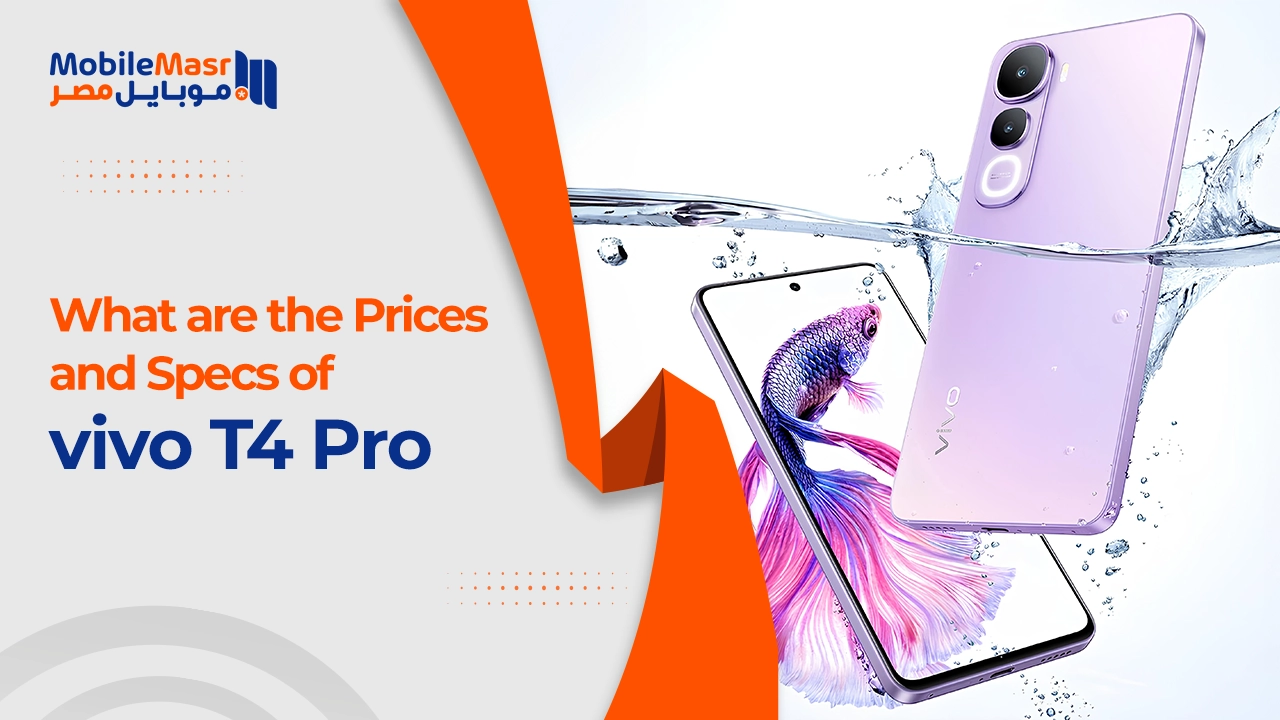
What Are vivo T4 Pro 2026 Specs & Price in Egypt?
What Makes the Vivo T4 Pro 2026 Worth Buying in Egypt?
The vivo T4 Pro arrived in 2025 as one of the most ambitious mid-range releases vivo has put together, and its reputation has only grown stronger heading into 2026. This is a phone that refuses to play small — packing a 50MP Sony IMX882 periscope telephoto camera with 3x optical zoom, a quad-curved 6.77-inch AMOLED display, a Snapdragon 7 Gen 4 processor, a 6,500mAh silicon-carbon battery with 90W FlashCharge, and IP68/IP69 dual water resistance into a body just 7.53mm thin. For Egyptian buyers looking at the 16,000 EGP mid-range segment, the vivo T4 Pro stacks up as one of the strongest all-round devices available. Whether you're a photography enthusiast, a heavy user who lives on their phone, or someone who just wants a reliable daily driver that goes beyond the ordinary, this guide covers everything you need to know.
What Is the vivo T4 Pro 2026 and Who Is It For?
The vivo T4 Pro represents vivo's T-series at its most ambitious — a line that has always positioned itself as value-driven but has, with this iteration, stepped convincingly into near-flagship territory. This isn't a phone of incremental upgrades over its predecessor. The vivo T4 Pro introduces a periscope telephoto lens previously reserved for premium flagship devices, a third-generation silicon-carbon battery technology, IP68/IP69 waterproofing, and Schott Diamond Shield Glass for drop resistance — features that most phones at this price tier simply don't include. Understanding where the T4 Pro sits and what it was designed to solve helps frame why it's worth serious consideration in Egypt's competitive 2026 smartphone market.
What Is the Story Behind the vivo T4 Pro Series?
The vivo T4 Pro launch date was August 26, 2025, in India — one of vivo's primary markets — where it entered at an aggressive price point targeting the upper mid-range segment. The T-series has historically served buyers who want performance and features without crossing into premium pricing, and the T4 Pro pushes this philosophy further than any previous model. What makes the T4 Pro's story particularly interesting is the clear engineering brief behind it: vivo wanted to bring two flagship-tier capabilities — a periscope zoom camera and silicon-carbon battery technology — into a device accessible to the mid-range buyer. The result is a phone that reviewers have called "vivo's most confident T-series phone yet," which is a meaningful statement given how strong previous iterations have been.
How Does the T4 Pro Fit Into vivo's Lineup?
Within vivo's broader lineup, the vivo T4 Pro occupies the upper tier of the T-series — positioned above the standard T4 (which uses the Snapdragon 7s Gen 3), above the T3 Pro from the previous generation, and below the V-series flagship tier. The T4 Pro's Snapdragon 7 Gen 4 processor gives it processing credentials that approach but don't reach the Snapdragon 8-series territory of vivo's premium V60 lineup. On camera, however, the periscope telephoto lens on the T4 Pro actually matches or exceeds what many V-series models offer. This cross-tier camera performance is one of the vivo T4 Pro features that makes it particularly interesting — it delivers photography results associated with phones that cost considerably more.
What Problems Did vivo Try to Solve With the T4 Pro?
The core problem vivo addressed with the vivo T4 Pro is the persistent gap in mid-range cameras around zoom and telephoto performance. Most mid-range phones include a 2MP depth sensor disguised as a "telephoto" lens that delivers no real zoom advantage. The T4 Pro breaks this pattern with a genuine 50MP periscope telephoto camera delivering 3x optical zoom — a capability that transforms portrait photography and distant subject capture. The second problem solved was battery anxiety in mid-range devices. By applying third-generation silicon-carbon battery technology (the same advancement used in premium EVs) to a smartphone, vivo fitted 6,500mAh of capacity into a 7.53mm slim body without the thickness penalty that large batteries traditionally impose. These two solutions make the vivo T4 Pro a phone built to fix the specific frustrations of mid-range buyers.
Who Is the Target Audience for the vivo T4 Pro 2026?
The vivo T4 Pro targets the Egyptian mid-range buyer who has been burned by compromise — someone who's had a phone with a mediocre zoom camera that couldn't capture portraits the way they wanted, or a phone whose battery didn't make it through the day. This is a buyer who values genuine feature substance over marketing language, who appreciates a premium display and build quality, and who has a budget in the 16,000 EGP range that they want to spend wisely. Vivo T4 Pro availability in Egypt makes it accessible to buyers across Cairo, Alexandria, and other major cities through multiple retail channels.
Is the vivo T4 Pro a Good Choice for Students in Egypt?
For Egyptian students, the vivo T4 Pro is a strong choice at the 16,000 EGP price point — though it sits above what would typically be called a student budget, students who are making a deliberate investment in a multi-year device will find it justified. The 6,500mAh battery carries through full days of lectures, commuting, and evening study without anxiety. The AMOLED display with 120Hz refresh rate is comfortable for long reading sessions and video content. The 50MP telephoto camera enables quality portrait photography and document capture with excellent detail. The IP68/IP69 rating adds confidence for users who aren't careful about liquid exposure. For students who can make the budget stretch, the vivo T4 Pro offers a more capable multi-year experience than devices at lower price points.
Is the vivo T4 Pro Suitable for Business and Work Use?
The vivo T4 Pro performs well for business use in Egypt. The professional photography capability — particularly the periscope telephoto for document capture, product photography, and client presentations — is a genuine work tool. The large display reads emails and spreadsheets comfortably. NFC support enables contactless payment where infrastructure is available. The IP68/IP69 rating means the phone can be used in varied environments without concern about light rain or liquid exposure. Software productivity is supported by Android 15 with Funtouch OS 15, which offers multi-window use, a quick launch sidebar, and comprehensive app ecosystem access. The two-day battery ensures no mid-meeting scramble for a charger. For Egyptian professionals who want a single device that handles both personal and professional demands well, the vivo T4 Pro delivers.
What Are the Full Specifications of the vivo T4 Pro 2026?
Here's the complete technical picture before diving into detailed analysis:
- Display: 6.77-inch quad-curved AMOLED, 1080 x 2392 (1.5K), 120Hz, 5,000 nits peak, 30-bit color
- Processor: Qualcomm Snapdragon 7 Gen 4 (SM7750-AB), 1x 2.8 GHz Cortex-A720 + 4x 2.4 GHz Cortex-A720 + 3x 1.8 GHz Cortex-A520
- GPU: Qualcomm Adreno 722
- RAM: 8GB or 12GB (2133 MHz)
- Storage: 128GB or 256GB (UFS 3.1)
- Rear Cameras: 50MP Sony IMX882 (f/1.8, OIS, PDAF) + 50MP periscope telephoto (3x optical zoom) + 2MP depth
- Front Camera: 32MP
- Battery: 6,500mAh Li-Polymer (3rd-gen silicon-carbon), 90W FlashCharge
- OS: Funtouch OS 15 (Android 15)
- Connectivity: 5G, Wi-Fi 5 (dual-band), Bluetooth 5.4, NFC, GPS, USB-C 2.0
- Durability: IP68 + IP69, Schott Diamond Shield Glass
- Security: Under-display fingerprint, face unlock
- Dimensions: 163.53 x 76.69 x 7.53mm, 192g
- Colors: Lava Red, Midnight Black, Aqua Blue
- Release Date: August 26, 2025
What Processor Powers the vivo T4 Pro 2026?
The vivo T4 Pro processor is the Qualcomm Snapdragon 7 Gen 4 (model SM7750-AB) — a chipset that represents a meaningful step up from previous mid-range Snapdragon generations. The CPU configuration uses a three-tier cluster arrangement: one prime core at 2.8 GHz (Cortex-A720 architecture), four performance cores at 2.4 GHz (also Cortex-A720), and three efficiency cores at 1.8 GHz (Cortex-A520). This configuration provides strong single-core burst performance from the 2.8 GHz prime core — important for gaming, camera processing, and demanding app launches — alongside efficient multi-threaded performance for sustained workloads. Graphics are handled by the Adreno 722 GPU, which provides solid gaming performance across the popular mobile gaming titles that dominate Egypt's gaming scene. The vivo T4 Pro processor powers the entire experience, from AI camera processing to 5G modem operation, with the efficiency expected from a modern upper-mid-range chipset.
How Does the vivo T4 Pro Chipset Compare to Competitors?
The Snapdragon 7 Gen 4 in the vivo T4 Pro positions the phone competitively against mid-range alternatives. The Geekbench multi-core score for this chipset configuration comes in around 3,641 — a strong showing for the price tier. Against MediaTek Dimensity-powered alternatives in the same price range, the Snapdragon 7 Gen 4 trades blows — it's not definitively faster than the best Dimensity mid-range chips, but benefits from Qualcomm's optimization for camera processing (via the Spectra ISP) and power efficiency tuning. The vivo T4 Pro benchmarks confirm a chipset that comfortably handles everything the mid-range buyer needs without the thermal constraints that sometimes affect more aggressively clocked alternatives. The pairing of this chipset with UFS 3.1 storage makes the performance feel more premium than the processor number alone suggests.
What Performance Benchmarks Has the T4 Pro Achieved?
In benchmark testing, the vivo T4 Pro achieves approximately 620,000-650,000 in AnTuTu, Geekbench multi-core around 3,641, and strong scores in GPU benchmarks from the Adreno 722. In practical performance tests like PCMark Work, the phone scores competitively for its chipset tier. 91mobiles' battery benchmark showed the T4 Pro delivering 15 hours and 21 minutes of screen-on time in the PCMark battery test — comfortably ahead of many competitors in its class. The vivo T4 Pro performance in real-world tests consistently matches or slightly exceeds what the raw benchmark numbers suggest, partly due to the well-optimized Funtouch OS 15 software layer that doesn't add unnecessary processing overhead. These vivo T4 Pro benchmarks paint a picture of a well-tuned mid-range device that delivers on its specifications in practice.
What Are the Display Specs of the vivo T4 Pro?
The vivo T4 Pro display is a standout feature — a quad-curved 6.77-inch AMOLED panel with 120Hz refresh rate that sits at 1.5K resolution and delivers 5,000 nits of peak brightness. "Quad-curved" refers to the display curving on all four edges, creating an immersive visual experience with minimal bezel intrusion and a premium aesthetic previously associated with flagship devices. The 30-bit color depth means the panel can display approximately 1 billion colors — eliminating the color banding artifacts visible on standard 24-bit (16 million color) displays, particularly noticeable during gradient-heavy content. For Egyptian users who consume video content, social media imagery, and photography through their phone, the T4 Pro's display provides a genuinely premium viewing experience.
What Screen Size and Resolution Does the vivo T4 Pro Have?
The vivo T4 Pro screen measures 6.77 inches diagonally at 1080 x 2392 pixel resolution — commonly referred to as 1.5K — with a pixel density of approximately 388 PPI. At this density, text and images are sharp and clean to the naked eye under normal viewing conditions. The 20:9 aspect ratio provides comfortable widescreen video viewing at near full-screen. The AMOLED technology delivers true black pixels in dark scenes (since OLED pixels turn off rather than displaying a grey backlit black), creating exceptional contrast ratios that LCD panels cannot replicate. The quad-curved design reduces the visible bezel to near zero on the sides, making the screen feel larger than its 6.77-inch diagonal implies. For vivo T4 Pro screen quality at this price, the combination of size, resolution, and AMOLED technology is among the best available in Egypt's mid-range market.
Does the vivo T4 Pro Support High Refresh Rate?
Yes — the vivo T4 Pro supports a 120Hz display refresh rate, meaning the screen updates 120 times per second. The practical result is visibly smoother scrolling through social media, more fluid interface navigation, and a more responsive gaming experience compared to 60Hz displays. The 120Hz AMOLED combination is particularly effective — OLED pixels respond faster than LCD to refresh rate commands, making the smoothness advantage more pronounced than on LCD panels running at the same refresh rate. The vivo T4 Pro display refresh rate can typically be set to adaptive mode, which intelligently scales between 60Hz and 120Hz based on content type — conserving battery during static content display while delivering maximum smoothness during scrolling and gaming.
How Is the Brightness and Outdoor Visibility on the T4 Pro?
The vivo T4 Pro display achieves 5,000 nits peak brightness — one of the highest peak brightness specifications available in its price class. Peak brightness activates in high-ambient-light conditions when the device's sensors detect direct sunlight, boosting output to ensure screen content remains clearly legible outdoors. In Egypt's intense sunlight — which can challenge displays with lower peak brightness significantly — the T4 Pro's 5,000 nit capability makes it one of the more outdoor-usable screens in the mid-range segment. Standard brightness for indoor and shaded use is considerably lower (and more comfortable for the eyes) while the peak brightness serves as an on-demand resource for the most challenging lighting conditions.
How Much RAM and Storage Does the vivo T4 Pro Offer?
The vivo T4 Pro RAM options are 8GB and 12GB, both running at 2133 MHz. Storage options are 128GB and 256GB, both using UFS 3.1 — a fast storage standard that contributes to quick app launches, rapid photo saves, and smooth file operations. Vivo's extended RAM (virtual RAM) feature allows the physical RAM to be supplemented by a portion of the storage, effectively expanding available memory beyond the physical limit — useful for keeping more apps in background memory simultaneously. The 12GB + 256GB configuration is the recommended choice for power users who multitask heavily or game extensively, while the 8GB + 128GB variant serves everyday users well within their use case.
What RAM Options Are Available for the vivo T4 Pro?
The vivo T4 Pro comes in two RAM tiers: 8GB for the base configuration and 12GB for the premium configuration. The 8GB variant handles everyday multitasking smoothly — social media, messaging, streaming, navigation, and camera operation all coexist in memory without the reloading lag that lower-RAM phones experience. The 12GB variant is aimed at users who keep multiple demanding apps running simultaneously — gaming with background apps, video editing alongside social media, or professional multi-app workflows. Both RAM configurations support vivo's virtual RAM extension, which can add up to 8GB of virtual memory from the storage, providing additional headroom during RAM-intensive operations. For the Egyptian buyer making the 16,000 EGP investment, the 8GB variant in the base configuration delivers strong value, while the 12GB variant is the definitive choice for maximum longevity and performance.
Can You Expand Storage on the vivo T4 Pro?
The vivo T4 Pro does not feature a dedicated MicroSD card slot — internal storage is fixed at 128GB or 256GB depending on the variant purchased. With approximately 110-115GB of usable storage available at 128GB (after OS overhead), the base configuration covers typical user needs for apps, photos, and media. The 256GB variant provides approximately 230GB+ of usable storage — comfortable even for users with extensive photo libraries and local media collections. For users who need storage flexibility beyond 256GB, cloud storage services (Google One, vivo's own cloud) provide the practical complement to fixed internal storage. The absence of MicroSD is a trade-off vivo made in favor of the slim 7.53mm body, which required engineering compromises.
What Are the Connectivity Features of the vivo T4 Pro?
The vivo T4 Pro connectivity suite is comprehensive for its tier: 5G (SA and NSA), dual-band Wi-Fi 5 (802.11 a/b/g/n/ac), Bluetooth 5.4, NFC, GPS with A-GPS/GLONASS/BeiDou/Galileo/NavIC/QZSS, and USB-C 2.0. Dual Nano-SIM support accommodates two active SIM cards simultaneously, ideal for Egyptian users managing work and personal numbers or combining networks for optimal coverage and data pricing.
Does the vivo T4 Pro Support 5G in Egypt?
Yes — the vivo T4 Pro is a 5G device, supporting both Sub-6GHz SA and NSA 5G architectures through the Snapdragon 7 Gen 4's integrated modem. Egyptian carrier 5G rollout is progressing through 2025-2026, primarily in major urban centers including Cairo and Alexandria. For Egyptian buyers investing in the vivo T4 Pro at 16,000 EGP, 5G capability ensures the device is ready for Egypt's expanding network infrastructure — even if 5G coverage isn't universally available at the time of purchase, it will grow throughout the phone's ownership period. In areas with only 4G LTE coverage, the T4 Pro connects to 4G seamlessly.
What Wi-Fi and Bluetooth Standards Does the T4 Pro Support?
The vivo T4 Pro supports dual-band Wi-Fi 5 (802.11 a/b/g/n/ac) across 2.4GHz and 5GHz frequencies. The 5GHz band support is particularly useful in Egypt's urban apartments where 2.4GHz Wi-Fi can be congested by neighboring networks, resulting in slower speeds. The T4 Pro's 5GHz capability enables faster, less congested wireless connections where a compatible router is available. Note that the T4 Pro uses Wi-Fi 5 rather than Wi-Fi 6 — a limitation compared to some competing devices at similar prices that have adopted Wi-Fi 6. For most practical daily use cases, Wi-Fi 5 delivers fully adequate speed. Bluetooth 5.4 provides the latest standard for wireless accessories, with improved connection stability and audio codec support.
Does the vivo T4 Pro Have NFC?
Yes — the vivo T4 Pro includes NFC (Near Field Communication). NFC enables contactless payment through compatible payment platforms, fast Bluetooth accessory pairing via NFC tap, NFC tag reading for smart home automation, and data transfer with other NFC-enabled devices. In Egypt, contactless payment infrastructure is expanding — NFC is increasingly usable in larger retail chains, hotels, and select restaurants in Cairo and Alexandria. As digital payment adoption grows throughout Egypt over the T4 Pro's ownership period, NFC's practical daily utility will increase, making its inclusion a forward-looking connectivity asset.
What Are the Dimensions and Weight of the vivo T4 Pro?
The vivo T4 Pro measures 163.53 x 76.69 x 7.53mm and weighs 192 grams. The 7.53mm thickness deserves special attention — fitting a 6,500mAh silicon-carbon battery into a body this slim is a notable engineering achievement. At 192 grams, the phone is solidly present in hand without being cumbersome, and the weight is distributed evenly across the body for balanced handling. The quad-curved design reduces the sense of the phone's width, making it feel smaller than its 76.69mm width suggests during single-handed use.
How Does the T4 Pro Feel in Hand Compared to Other Phones?
The vivo T4 Pro feels premium in hand — the quad-curved AMOLED screen flowing into the body's edges creates a seamless, polished tactile experience. The 7.53mm thinness means the phone slides into pockets without bulk. Compared to competing phones at similar prices that carry similarly large batteries, the T4 Pro is among the thinnest options available — a benefit of the silicon-carbon battery technology. The Schott Diamond Shield Glass on the front is smooth and resistant to casual contact abrasion. Overall, the vivo T4 Pro design feels more expensive than its price, which is consistent feedback from reviewers who have handled the device.
Is the vivo T4 Pro Dustproof or Waterproof?
Yes — the vivo T4 Pro carries IP68 and IP69 dual certification for water and dust resistance. IP68 certifies submersion protection in up to 1.5 meters of fresh water for 30 minutes. IP69 certifies protection against high-pressure water jets. This dual IP rating at a mid-range price point is exceptional — many smartphones at significantly higher prices offer only IP67 or IP68 without the additional IP69 certification. Combined with Schott Diamond Shield Glass for drop protection, the vivo T4 Pro is built to survive the accidents of daily life with unusual confidence for its price tier.
What Camera System Does the vivo T4 Pro 2026 Have?
The vivo T4 Pro camera is the device's most compelling headline feature — particularly the periscope telephoto lens, which is genuinely unusual in the mid-range segment and represents a meaningful functional upgrade over the standard depth sensors that most competing phones include as their "third camera."
What Is the Main Camera Spec on the vivo T4 Pro?
The main camera on the vivo T4 Pro is a 50MP Sony IMX882 sensor — a premium Sony sensor designation that signals real investment in image quality. The Sony IMX882 delivers accurate color reproduction, strong dynamic range in high-contrast scenes, and excellent detail capture in well-lit conditions. This is the same Sony sensor branding that vivo uses in its premium V-series devices, making its inclusion in the T4 Pro a meaningful specification rather than a marketing claim. The 50MP resolution enables either full-resolution detail shots or pixel-binned 12.5MP output with improved light gathering. The vivo T4 Pro camera system, anchored by this sensor, delivers primary photography quality that challenges devices at higher price points.
What Aperture and Sensor Size Does the T4 Pro Main Camera Use?
The vivo T4 Pro main camera uses an f/1.8 aperture — wide enough to gather substantial light in moderately dim conditions and produce background blur in portrait mode naturally through the combination of aperture and focal length. The Sony IMX882 is a 1/1.56-inch sensor — larger than the sensors found in typical mid-range phones, which commonly use 1/2.0-inch or smaller sensors. A larger sensor captures more light per pixel, improving low-light performance and dynamic range. This sensor size, combined with the f/1.8 aperture, gives the vivo T4 Pro main camera genuine low-light capability that exceeds what most phones at this price tier deliver.
Does the vivo T4 Pro Support OIS?
Yes — the vivo T4 Pro supports Optical Image Stabilization (OIS) on the main 50MP camera. OIS physically moves the camera sensor to counteract hand tremor during photography, producing sharper handheld shots at slower shutter speeds (useful in low light) and smoother video during walking or motion. OIS is a hardware feature that's expensive to implement and therefore often absent from mid-range devices — its presence on the T4 Pro main camera is a meaningful quality differentiator. Combined with Electronic Image Stabilization (EIS) for video, the T4 Pro produces noticeably more stable images and footage than OIS-free competitors.
How Many Cameras Does the vivo T4 Pro Have on the Back?
The vivo T4 Pro features three rear cameras: the 50MP Sony IMX882 main sensor, a 50MP periscope telephoto camera with 3x optical zoom, and a 2MP depth sensor. The triple camera count is less important than the quality of what those cameras actually do — and the 50MP periscope telephoto is what makes the T4 Pro's camera system genuinely distinctive in its price class. A periscope telephoto works by orienting the telephoto lens horizontally within the phone's body and using a prism to redirect light, allowing a much longer focal length than a standard straight telephoto without adding phone thickness. The result is true 3x optical zoom that captures subject detail at distance with clarity that no software zoom algorithm can replicate.
What Is the Ultrawide Camera Like on the vivo T4 Pro?
The vivo T4 Pro does not include an ultrawide camera — a notable omission that some reviewers have pointed out as a gap. The triple camera system consists of a main sensor, periscope telephoto, and depth sensor rather than the more common main + ultrawide + depth configuration. For buyers who frequently shoot landscape photography or group photos from close range where an ultra-wide perspective would be valuable, this absence is a genuine limitation. Vivo's design decision reflects a philosophy of providing the best zoom and portrait capability within three camera slots rather than spreading the hardware budget across an additional ultrawide sensor. For users who primarily shoot portraits, travel subjects, and everyday life rather than architectural photography or wide-angle landscapes, the tradeoff is acceptable.
Does the vivo T4 Pro Include a Macro or Depth Lens?
The third rear camera on the vivo T4 Pro is a 2MP depth sensor — used to improve portrait mode background blur by accurately mapping depth in the scene. The depth sensor improves the AI portrait mode's subject-background separation accuracy, particularly around hair and irregular edges. There is no dedicated macro lens on the T4 Pro; extreme close-up photography uses the main camera's minimum focus distance rather than a dedicated macro hardware sensor. This is a consistent approach from vivo — prioritizing a quality depth sensor for portrait improvement over the 2MP macro lenses that many competing phones include primarily for specification count.
How Good Is the vivo T4 Pro Front Camera for Selfies?
The vivo T4 Pro front camera is a 32MP unit — a notably high resolution for a mid-range selfie camera that produces detailed, sharp selfies with plenty of resolution for cropping and social media sharing. At 32MP, the front camera captures fine facial detail and produces portrait selfies that look professional without requiring extensive post-processing. Vivo's selfie processing pipeline — which has been a consistent brand strength — applies natural-looking AI enhancement that flatters without artificiality. The 32MP front camera records video at up to 4K resolution, making the T4 Pro's selfie camera capable for content creators as well as everyday social media users.
What Megapixel Count Does the T4 Pro Selfie Camera Have?
The vivo T4 Pro selfie camera delivers 32MP resolution — a step up from the 16MP selfie cameras common in the mid-range tier and the 8MP selfie camera found on some direct competitors like the vivo Y500 China Edition. At 32MP, selfies contain enough detail for significant post-crop flexibility while delivering clean, sharp full-frame shots. The f/2.0 aperture gathers adequate light for indoor selfie situations. Combined with vivo's AI portrait mode on the front camera — with adjustable bokeh and natural skin enhancement — the T4 Pro's selfie capabilities satisfy both casual snappers and more deliberate portrait photographers.
Does the vivo T4 Pro Front Camera Support Portrait Mode?
Yes — the vivo T4 Pro's front camera supports portrait mode with AI-based background segmentation and adjustable bokeh blur intensity. The portrait mode on the front camera uses AI depth estimation to separate the subject from the background, applying blur that simulates the look of a wide-aperture portrait lens. Edge detection — particularly around hair, which is the most challenging portrait boundary — is well-handled by vivo's portrait processing algorithm. The result is portrait selfies that look polished and professional. The strength of the background blur effect is adjustable from subtle to strong, and beauty enhancement features are independently controllable for users who want portrait framing without the skin smoothing effect.
What Video Recording Capabilities Does the vivo T4 Pro Have?
The vivo T4 Pro supports 4K video recording at 30fps from the rear main camera, 1080p at up to 60fps for slow-motion-friendly high frame rate video, and 4K recording from the 32MP front camera — a comprehensive video capability set that covers content creation, travel videography, and everyday memory capture. The periscope telephoto camera can also record video at its native zoom level, enabling zoomed footage with optical quality rather than digital zoom degradation.
Can the vivo T4 Pro Record 4K Video?
Yes — the vivo T4 Pro records 4K video at 30fps from both the rear main camera and the 32MP front camera. 4K recording delivers four times the pixel count of 1080p, resulting in footage with substantially more detail — useful for video that will be cropped, stabilized in post-production, or viewed on large screens. For content creators who shoot vlog-style content for YouTube or cinematic footage for social media, 4K front and rear recording is a practical capability. The vivo T4 Pro review community has specifically praised the telephoto camera's video quality, which maintains optical zoom clarity in video mode — a feature that software zoom algorithms can't match.
Does the T4 Pro Support Video Stabilization?
Yes — the vivo T4 Pro supports both Optical Image Stabilization (OIS) for hardware-level stabilization and Electronic Image Stabilization (EIS) for software-level stabilization. In video mode, the combination of OIS and EIS produces footage that's smooth enough for handheld vlog recording without a gimbal. Walking shots show minimal jitter. The OIS is particularly effective for slow panning shots where maintaining a steady horizontal movement is challenging without hardware stabilization. For users who want professional-looking video from a handheld smartphone, the T4 Pro's stabilization system is one of the stronger implementations available at this price tier.
How Does the vivo T4 Pro Camera Perform in Low Light?
Low-light photography on the vivo T4 Pro benefits from several hardware and software advantages: the f/1.8 aperture of the main lens, the 1/1.56-inch Sony IMX882 sensor size, OIS for longer exposure handheld shots, and vivo's Night Mode computational photography pipeline. The result is low-light main camera performance that exceeds most competing mid-range phones. In typical Egyptian evening scenarios — urban streetlighting, indoor restaurant lighting, building lobbies — the T4 Pro produces detailed, low-noise images with accurate color reproduction that are immediately shareable without post-processing.
Does the vivo T4 Pro Have a Night Mode?
Yes — the vivo T4 Pro includes a dedicated Night Mode that uses multi-frame capture and computational blending to produce optimized low-light images. Night Mode takes multiple frames at different exposures and merges them to recover shadow detail, reduce noise, and balance highlights. On the T4 Pro, Night Mode processes quickly (typically 2-3 seconds from capture to preview) and produces results that are consistently better than standard Auto mode in challenging lighting. OIS during Night Mode capture allows slightly longer individual frame exposures than would be possible handheld without stabilization, further improving the quality of the merged output. The vivo T4 Pro camera in Night Mode is a genuine strong performer for the price tier.
How Does the T4 Pro Compare in Night Photography vs Rivals?
The vivo T4 Pro's night photography advantage comes primarily from the combination of the Sony IMX882 sensor's size, OIS, and f/1.8 aperture — a hardware trifecta that most competing phones at this price offer only one or two components of. Against mid-range alternatives with smaller sensors or no OIS, the T4 Pro's night shots show noticeably better detail retention and lower noise. The periscope telephoto camera also performs above average in night conditions for a zoom camera — though like all telephoto lenses, it's more limited in low light than the wider-aperture main camera. The vivo T4 Pro review from 91mobiles specifically praised the telephoto as "the star of the T4 Pro," producing "sharp, detailed shots that most rivals at this price bracket can't deliver" — praise that applies to both day and low-light zoom photography.
How Long Does the vivo T4 Pro 2026 Battery Last?
Battery performance is a central pillar of the vivo T4 Pro's value proposition, and the combination of 6,500mAh capacity with third-generation silicon-carbon chemistry makes it one of the most enduring batteries in the mid-range segment.
What Is the Battery Capacity of the vivo T4 Pro?
The vivo T4 Pro battery holds 6,500mAh — delivered through third-generation silicon-carbon anode technology that provides higher energy density than conventional lithium-polymer cells. This technology enables a larger energy reservoir without the proportional size increase that conventional batteries would require, which is why vivo managed to fit 6,500mAh into a 7.53mm thin body. The silicon-carbon chemistry also offers improved longevity — vivo promises the battery retains 80% health after 1,300 charge cycles, which translates to approximately four years of daily charging before significant capacity degradation is expected. The vivo T4 Pro battery is not just large today; it's engineered to remain large (relative to its starting capacity) for years of ownership.
How Many Hours of Screen-On Time Can You Get From the T4 Pro?
The vivo T4 Pro delivers approximately 15 hours and 21 minutes of screen-on time in PCMark battery tests — a benchmark that places it comfortably ahead of most competitors in its class. In real-world use under moderate daily patterns (social media, messaging, streaming, navigation, camera), the phone regularly reaches 18 to 24 hours from a full charge before reaching the need to top up. For moderate users — those with 4-6 hours of active screen time per day — the vivo T4 Pro is effectively a two-day phone, meaning charging every other evening rather than every night. Heavy users who run the screen continuously for gaming and streaming should expect a full day with meaningful battery remaining. The vivo T4 Pro battery life is among the most practical features the phone offers.
How Does the T4 Pro Battery Compare to Other Phones in Its Class?
Against the most common competitors in Egypt's mid-range market, the vivo T4 Pro's 6,500mAh battery leads or competes at the top. Most mid-range smartphones carry 4,500-5,500mAh batteries — the T4 Pro's silicon-carbon 6,500mAh cell holds approximately 1,000 to 2,000mAh more than these alternatives, which translates directly to substantially longer daily endurance. The 91mobiles PCMark test showed the T4 Pro outlasting competitors including the Motorola Edge 60 Pro (8 hours 27 minutes) and the Realme P4 Pro (17 hours 17 minutes — slightly ahead), confirming the T4 Pro's position as a battery endurance leader in its tier. For Egyptian users who prioritize not running out of charge during their day, the T4 Pro is among the safest choices available.
Does the vivo T4 Pro Support Fast Charging?
Yes — the vivo T4 Pro supports 90W FlashCharge wired fast charging, vivo's proprietary fast charging standard that delivers the fastest safe charging speed the silicon-carbon battery supports. The 90W charger is included in the box, meaning no additional purchase is needed to access this capability. Vivo also supports bypass charging on the T4 Pro — a feature that allows the phone to run directly from wall power during gaming or heavy use, bypassing the battery entirely to prevent heat generation during charging-while-gaming scenarios.
How Fast Can the vivo T4 Pro Fully Charge?
At 90W, the vivo T4 Pro charges from 20% to full in approximately 40 minutes — a remarkable speed for a 6,500mAh battery. A 15-minute charge provides approximately 30-35% battery — enough for several more hours of moderate use. The combination of a large battery and fast charging addresses the traditionally frustrating trade-off in battery design: either you have a large battery that's slow to refill, or a small battery that charges quickly but runs out fast. The T4 Pro offers genuine endurance AND fast recovery when the battery does run low. The vivo T4 Pro charging speed at 90W is one of the fastest available at its price tier.
Does the vivo T4 Pro Support Wireless Charging?
No — the vivo T4 Pro does not support wireless charging. This is consistent with most phones in the mid-range segment where wireless charging hardware adds cost and thickness that most buyers at this price are not specifically requesting. The 90W wired charging is fast enough that the absence of wireless charging has minimal practical impact for most users — a 30-minute wired top-up while eating a meal provides more charge than most wireless charging sessions would deliver in the same time. For buyers who specifically want wireless charging, this is a genuine limitation; for the majority, the 90W wired speed more than compensates.
What Software and UI Does the vivo T4 Pro 2026 Run?
What Android Version Does the vivo T4 Pro Come With?
The vivo T4 Pro launched with Android 15 under Funtouch OS 15 — the most current major Android version at the time of its August 2025 release. The device subsequently received an update to Android 16 (OriginOS 6 equivalent for markets receiving OriginOS) in January 2026, demonstrating vivo's commitment to prompt major Android updates for the T4 Pro. Launching on Android 15 and receiving Android 16 within approximately five months of the Android 16 release confirms the T4 Pro is on an active update schedule.
What Version of Funtouch OS Does the T4 Pro Use?
The vivo T4 Pro runs Funtouch OS 15 — vivo's latest custom Android skin, built on Android 15 (and updateable to Android 16). Funtouch OS 15 offers a refined visual design, improved multi-window multitasking, an enhanced AI camera interface, battery management controls, a comprehensive theme engine, and a cleaner notification management system compared to earlier Funtouch versions. The interface strikes a balance between feature richness and operational simplicity — offering extensive customization options for users who want them without burdening users who prefer a clean, standard experience. The vivo T4 Pro features within Funtouch OS 15 include Smart Sidebar for quick app access, Multi-Turbo for gaming optimization, and various productivity tools accessible from the settings menu.
How Many Android Updates Will the vivo T4 Pro Receive?
Based on vivo's stated support commitment and industry precedent for flagship-adjacent T-series devices, the vivo T4 Pro is expected to receive two to three major Android version updates from its Android 15 launch baseline, with security patches delivered for at least three years. The Android 16 update already received within months of launch reinforces this trajectory. For Egyptian buyers purchasing the T4 Pro at 16,000 EGP as a multi-year device investment, the software support outlook is positive — the phone should remain current on Android through at least 2027-2028, covering a typical two to three year ownership cycle comfortably.
What AI Features Does the vivo T4 Pro 2026 Include?
AI integration on the vivo T4 Pro spans camera, battery, and performance domains — making it a pervasive influence on the daily experience rather than a collection of gimmick features. Vivo has invested specifically in on-device AI that processes locally on the Snapdragon 7 Gen 4's NPU (Neural Processing Unit) rather than relying exclusively on cloud-based AI services.
Does the vivo T4 Pro Have AI Camera Enhancements?
Yes — AI camera enhancements on the vivo T4 Pro include real-time scene recognition (automatically adjusting settings for over 20 scene types), AI portrait enhancement for natural-looking skin and facial optimization, AI noise reduction in low light, AI-enhanced Night Mode processing, and AI-powered video stabilization optimization. The periscope telephoto camera specifically benefits from AI-powered zoom enhancement that improves edge sharpness and reduces chromatic aberration in zoomed images. The vivo T4 Pro camera AI system runs in real time through the Snapdragon 7 Gen 4's NPU, ensuring AI processing doesn't add perceptible delay to the capture-to-preview pipeline.
What AI-Powered Battery or Performance Features Does the T4 Pro Have?
Funtouch OS 15 on the vivo T4 Pro includes AI-powered battery optimization that learns usage patterns over time and restricts background power consumption by apps the user rarely interacts with during specific time periods. Super Battery Saver mode restricts the phone to essential functions during critically low battery situations, dramatically extending standby time. Multi-Turbo — vivo's performance optimization suite — uses AI to allocate CPU and GPU resources dynamically based on the running application's demands, providing performance boosts for gaming and camera-intensive moments while conserving resources during light tasks. AI thermal management works alongside these features to prevent sustained performance throttling during extended heavy use.
Are There Any Bloatware Issues on the vivo T4 Pro?
The vivo T4 Pro ships with a moderate quantity of pre-installed applications — a mix of vivo's own utility apps, Google's standard suite, and some third-party applications. Vivo's own reviewers and the broader vivo T4 Pro review community note that the preloaded apps are "an annoyance" — particularly some third-party apps that install without explicit user consent. Most third-party pre-installed apps can be uninstalled through the standard Android settings menu. Google apps follow Google's uninstall/disable policies. Vivo's own system utilities remain but are functional tools rather than promotional content.
How Much Free Storage Is Available Out of the Box on the T4 Pro?
On the 128GB base storage vivo T4 Pro, approximately 108-115GB of usable storage is available after the operating system, Funtouch OS layers, pre-installed apps, and system files occupy their share. On the 256GB variant, usable storage is approximately 230-240GB. For users with typical app collections, moderate photo libraries, and some downloaded media, the 128GB configuration provides adequate initial space. For power users, content creators, or those who store extensive video or offline media locally, the 256GB variant is the more comfortable choice. Cloud backup for photos (Google Photos, vivo's cloud service) effectively extends the practical photo storage beyond what local storage alone supports.
What Is the Price of the vivo T4 Pro 2026 in Egypt?
The vivo T4 Pro is priced at 16,000 EGP in Egypt — positioning it in the upper mid-range tier where buyers are making deliberate, considered purchases. At 16,000 EGP, the T4 Pro competes in a segment where specification depth and build quality matter significantly, and its feature set justifies this investment convincingly.
What Is the Official vivo T4 Pro Price in Egypt?
The official vivo T4 Pro price in Egypt is 16,000 EGP for the primary variant available through Egyptian retail channels. This pricing reflects import costs, retail margin, and currency factors between the Indian launch price (where the phone entered at approximately ₹27,999 — roughly equivalent to its current Egyptian market positioning at exchange rates) and the Egyptian market. At 16,000 EGP, the T4 Pro's periscope telephoto, 6,500mAh silicon-carbon battery, IP68/IP69 dual rating, and AMOLED 120Hz quad-curved display represent a specification density that outclasses most alternatives at this Egyptian price point.
Where Can You Buy the vivo T4 Pro in Egypt?
The best place to buy the vivo T4 Pro in Egypt — for both price competitiveness and buyer assurance — is mobilemasr.com, Egypt's premier platform for new and used smartphones. Mobile Masr offers verified listings, competitive pricing, and knowledgeable customer service that can help buyers navigate configuration choices and compare the T4 Pro against alternatives at the same budget. Vivo authorized retailers and electronics hypermarkets across Cairo and Alexandria also stock the T4 Pro, providing the option of physical inspection before purchase.
Is the vivo T4 Pro Available on Installments in Egypt?
Yes — installment payment options for the vivo T4 Pro at its 16,000 EGP price are available through select Egyptian retailers and platforms. mobilemasr.com can advise on current installment terms, allowing buyers to spread the 16,000 EGP cost across several months for better cash flow management. Installment terms vary by provider and may involve a modest additional charge on the total price. For buyers who want the vivo T4 Pro's capabilities without a single large payment, installment purchasing through a verified channel is a practical approach.
How Does the vivo T4 Pro Price Compare to Similar Phones in Egypt?
At 16,000 EGP, the vivo T4 Pro positions itself above the entry of the mid-range segment and below the premium tier — a price point where several capable competitors operate. The T4 Pro's distinguishing specification at this price is the periscope telephoto camera and silicon-carbon battery combination, which no direct competitor at 16,000 EGP in Egypt currently matches simultaneously.
How Does the T4 Pro Price Compare to Xiaomi and Samsung Mid-Range Phones?
At 16,000 EGP, competing mid-range options from other brands are available — some with faster processors, some with ultrawide cameras, and some with longer software update commitments. The vivo T4 Pro's competitive advantage at this price is specifically in zoom photography and battery endurance — areas where the periscope telephoto and 6,500mAh silicon-carbon battery are unmatched by standard mid-range configurations. For buyers who prioritize these specific capabilities above others, the T4 Pro offers demonstrably better value than alternatives. For buyers who prioritize ultrawide photography or guaranteed long-term software updates above everything else, the price comparison may favor alternatives. mobilemasr.com is the recommended platform for current comparative pricing in Egypt.
Is the vivo T4 Pro the Best Value Phone at Its Price in Egypt?
For buyers whose priorities align with the T4 Pro's strengths — photography (especially zoom and portrait), battery life, build quality, and display quality — the vivo T4 Pro at 16,000 EGP is one of the strongest value propositions in Egypt's 2026 mid-range market. The periscope telephoto alone is a differentiator that competing phones at the same price simply don't match. For buyers with different priorities — ultra-wide photography, maximum gaming performance, or the longest possible software update support — the "best value" question becomes more nuanced, and comparing alternatives through mobilemasr.com's selection is advisable.
Has the vivo T4 Pro Price Changed Since Its Launch in Egypt?
The vivo T4 Pro's Egyptian market pricing at 16,000 EGP reflects the device's 2025-2026 market positioning. As with all imported smartphones in Egypt, pricing is influenced by exchange rate movements and import costs over time. The 16,000 EGP price is the current market rate for the T4 Pro in Egypt. Buyers tracking the phone over time may see modest price movements as stock levels and market conditions evolve.
What Were the Early Launch Prices for the T4 Pro in Egypt?
The vivo T4 Pro launched in Egypt at approximately the 16,000 EGP level, tracking the device's Indian launch pricing at ₹27,999 (base 8GB/128GB variant) adjusted for Egyptian market conditions. Early availability through import channels may have seen slightly higher pricing before wider distribution normalized the price. For the most current and accurate pricing, checking mobilemasr.com directly provides real-time market pricing that reflects actual current availability.
What Colors and Variants Does the vivo T4 Pro 2026 Come In?
What Color Options Are Available for the vivo T4 Pro in Egypt?
The vivo T4 Pro is available in three color options: Lava Red, Midnight Black, and Aqua Blue. Lava Red is the boldest choice — a vibrant gradient that makes the phone visually distinctive and works exceptionally well with the quad-curved glass's light-catching properties. Midnight Black delivers an understated, professional appearance with the smooth gradient AMOLED back surface resisting fingerprints well compared to high-gloss finishes. Aqua Blue offers a fresh, distinctive middle ground — vibrant enough to make a statement while being more subtle than Lava Red. All three vivo T4 Pro colors use the same premium glass-back construction, with the color finish applied beneath the glass for depth and durability.
Which Color Variant of the T4 Pro Is Most Popular in Egypt?
Based on general mid-range market color preferences in Egypt, Midnight Black typically sells most broadly — the professional, understated finish suits a wider demographic and hides daily wear more effectively. Lava Red performs particularly strongly with younger buyers who want their device to make a visual statement. Aqua Blue captures buyers who want something distinctive without the intensity of red. The vivo T4 Pro design across all three colors looks premium for the price tier, with the quad-curved AMOLED back creating a depth to the color that flat-back phones can't replicate.
Does the vivo T4 Pro Come in Different Storage Variants?
Yes — the vivo T4 Pro is available in two storage configurations: 8GB RAM + 128GB storage and 12GB RAM + 256GB storage. Both variants use UFS 3.1 storage. The 8GB/128GB configuration is the entry point that delivers the full T4 Pro feature set at the most accessible price. The 12GB/256GB configuration adds the headroom of extra RAM for heavier multitasking and doubles the base storage — the preferred choice for power users and content creators who want to maximize the phone's performance and storage longevity.
Which vivo T4 Pro Variant Offers the Best Value for Money?
For most Egyptian buyers at the 16,000 EGP price point, the 8GB/128GB variant delivers the best value — the T4 Pro's most distinctive features (periscope camera, silicon-carbon battery, IP68/IP69, AMOLED 120Hz) are identical across both variants, meaning the base configuration gives full access to what makes the T4 Pro special. The 12GB/256GB variant is worth the additional investment specifically for heavy gamers who demand maximum performance headroom and users whose photo/video capture or app collection regularly requires more than 128GB of local storage.
How Does the vivo T4 Pro 2026 Compare to Its Competitors?
How Does the vivo T4 Pro Compare to the Xiaomi Redmi Note 13 Pro?
The Redmi Note 13 Pro offers a more versatile camera system with an ultrawide lens — an area where the T4 Pro has a gap. The T4 Pro counters with a periscope telephoto camera that the Redmi Note 13 Pro cannot match, along with the silicon-carbon battery technology providing a meaningful endurance advantage. The Snapdragon 7 Gen 4 in the T4 Pro is a more current and capable chipset than what the Redmi Note 13 Pro's MediaTek Dimensity 7200 offers. The vivo T4 Pro vs Redmi Note 13 Pro comparison comes down to whether ultrawide coverage or periscope zoom matters more to the specific buyer.
Which Is Better for Gaming – T4 Pro or Redmi Note 13 Pro?
For gaming, the vivo T4 Pro holds an advantage due to the Snapdragon 7 Gen 4's Adreno 722 GPU performance, the 120Hz AMOLED display's smoothness advantage, and the T4 Pro's bypass charging feature that enables plugged-in gaming without battery heat accumulation. The T4 Pro's larger battery also means longer uninterrupted gaming sessions. The Redmi Note 13 Pro's Dimensity 7200 is capable but positions the T4 Pro as the stronger gaming device in this specific vivo T4 Pro vs comparison.
Which Has a Better Camera – T4 Pro or Redmi Note 13 Pro?
Camera comparison between the two phones depends on use case. For ultra-wide and versatile everyday photography, the Redmi Note 13 Pro's three-lens system with ultrawide has an advantage. For portrait and zoom photography, the T4 Pro's periscope telephoto with 3x optical zoom is definitively superior — no ultrawide comparison changes the fact that a 50MP periscope telephoto produces zoom quality the Redmi Note 13 Pro simply cannot match. For most everyday photography including portraits, the T4 Pro's camera is stronger; for landscape and architectural wide-angle photography, the Redmi Note 13 Pro's ultrawide gives it the advantage.
How Does the vivo T4 Pro Compare to the Samsung Galaxy A55?
The Samsung Galaxy A55 brings Samsung's brand recognition, One UI software polish, and a longer committed software update schedule (four years of major Android updates) alongside competitive camera hardware. The vivo T4 Pro counters with the periscope telephoto (absent on the A55), a significantly larger silicon-carbon battery, faster 90W charging (versus Samsung's typically slower charging on the A55), and IP68/IP69 dual rating at a comparable price. The vivo T4 Pro vs Galaxy A55 comparison is a genuine trade-off between Samsung's software longevity and the T4 Pro's hardware superiority in battery and zoom camera.
Which Has a Longer Battery Life – T4 Pro or Galaxy A55?
The vivo T4 Pro's 6,500mAh silicon-carbon battery outperforms the Samsung Galaxy A55's standard 5,000mAh battery in battery endurance testing — 15 hours 21 minutes versus the A55's typically shorter PCMark result. The T4 Pro's battery advantage is not marginal; users switching from an A55-tier battery experience to the T4 Pro will notice the difference daily. The T4 Pro also charges significantly faster (90W versus Samsung's slower charging), meaning the overall power management experience on the T4 Pro is superior in both endurance and recovery speed.
Which Phone Has a Better Display – T4 Pro or Galaxy A55?
The vivo T4 Pro's quad-curved AMOLED with 5,000 nits peak brightness and 120Hz refresh rate is a premium display. The Samsung Galaxy A55 also uses an AMOLED panel at 120Hz. Both deliver quality OLED experiences. The T4 Pro's 5,000 nits peak brightness and quad-curved design give it a visual edge in terms of outdoor legibility and premium aesthetic. Samsung's panel calibration and color accuracy are industry benchmarks, making this a close comparison that slightly favors the T4 Pro on brightness and the Galaxy A55 on color science reputation.
How Does the vivo T4 Pro Compare to the OPPO Reno11?
The OPPO Reno11 competes with a distinctive portrait-focused camera approach and OPPO's ColorOS software experience. The vivo T4 Pro counters with the Snapdragon 7 Gen 4 (potentially stronger than the Reno11's processor depending on configuration), the silicon-carbon battery capacity advantage, and the periscope telephoto that adds zoom capability the Reno11 lacks in its standard configuration. The vivo T4 Pro vs OPPO Reno11 comparison is close on camera artistic processing quality but strongly favors the T4 Pro on battery endurance and zoom capability.
Which Has Better Software Support – T4 Pro or OPPO Reno11?
Both vivo (Funtouch OS) and OPPO (ColorOS) build their respective Android skins on similar AOSP foundations, and both have been improving update commitments in recent years. The T4 Pro's Android 16 update within months of launch suggests a strong update trajectory. OPPO's ColorOS update record is similarly competitive for flagship-adjacent devices. For Egyptian buyers choosing between the two on software support, the distinction is modest — both should deliver at least two major Android updates over their support lifecycle.
How Does the vivo T4 Pro Compare to the Realme 12 Pro?
The Realme 12 Pro is a direct competitor in the mid-range segment, offering its own periscope telephoto camera and competitive specifications. The vivo T4 Pro vs Realme 12 Pro comparison is one of the most interesting in the segment, with both phones featuring periscope zoom as a differentiating camera feature. The T4 Pro's larger silicon-carbon battery and IP68/IP69 dual rating give it durable advantages that the Realme 12 Pro doesn't fully match.
Which Phone Has the Better Charging Speed – T4 Pro or Realme 12 Pro?
Both the vivo T4 Pro and Realme 12 Pro offer fast charging — Realme has been competitive on charging speed across its lineup. The T4 Pro's 90W FlashCharge delivers a full 6,500mAh charge in approximately 40-45 minutes from 20%. Realme's fast charging on the 12 Pro varies by specific configuration. The vivo T4 Pro charging speed at 90W for a larger capacity battery positions it well in this comparison — the combination of how much it charges (6,500mAh) and how fast it charges (90W) is the relevant metric rather than wattage alone.
What Are the Pros and Cons of the vivo T4 Pro 2026?
What Are the Main Advantages of Buying the vivo T4 Pro?
The vivo T4 Pro's advantages are significant and genuinely differentiating in the Egyptian mid-range market:
- 50MP periscope telephoto with 3x optical zoom — a flagship-tier camera feature at mid-range pricing
- 50MP Sony IMX882 main camera with OIS — premium sensor with hardware stabilization
- 6,500mAh silicon-carbon battery — exceptional endurance with longevity-engineered chemistry
- 90W FlashCharge — full charge in approximately 40 minutes
- IP68 + IP69 dual rating — the best water resistance available in its price class
- Schott Diamond Shield Glass — premium drop protection
- 6.77-inch quad-curved AMOLED — 120Hz, 5,000 nits, 30-bit color
- Snapdragon 7 Gen 4 — capable and efficient upper-mid-range performance
- Android 15/16 with Funtouch OS 15 — modern software with active update history
- NFC — contactless payment capable
- 7.53mm slim despite 6,500mAh battery — remarkable engineering balance
Why Do Users in Egypt Prefer the vivo T4 Pro Over Other Brands?
Egyptian users who choose the vivo T4 Pro typically cite the zoom camera as the primary differentiator — the 3x optical periscope telephoto is a feature they couldn't get from competing phones at the same budget, and its impact on portrait and travel photography is immediately apparent. The battery is the second consistent reason: two-day endurance for moderate users means the charging anxiety that accompanies most smartphones simply disappears. The IP68/IP69 rating appeals strongly to users who have had previous phones damaged by liquid exposure — it's a practical assurance that has real daily-use value in Egyptian life (at the beach, by the Nile, in rain). The vivo T4 Pro review feedback from Egyptian users captures these same priorities consistently.
What Are the Weaknesses or Drawbacks of the vivo T4 Pro?
The vivo T4 Pro's primary weaknesses are real and worth acknowledging clearly:
- No ultrawide camera — the most frequently mentioned gap, limiting wide-angle photography
- Pre-installed apps — moderate bloatware requiring a cleanup session after setup
- Wi-Fi 5 rather than Wi-Fi 6 — less competitive wireless standard than some rivals at this price
- No wireless charging — 90W wired charging compensates practically but the feature is absent
- No MicroSD expansion — fixed internal storage requires choosing the right variant at purchase
- Occasional heating during sustained heavy use — standard for the chipset tier but worth noting
- Chipset isn't the fastest — Snapdragon 7 Gen 4 is capable but not the segment's most powerful option
Is the vivo T4 Pro Missing Any Features That Competitors Offer?
The most significant missing feature relative to competitors is the ultrawide camera — a lens that most competing triple-camera phones include and that significantly expands photographic versatility. Some competing phones at the same price offer Wi-Fi 6 where the T4 Pro uses Wi-Fi 5. Wireless charging is absent where select competitors include it. These gaps are real but contextual — for buyers who specifically prioritize ultrawide photography or wireless charging, they represent deal-breakers worth exploring alternatives. For buyers who prioritize zoom photography and battery endurance, the vivo T4 Pro features more than compensate.
What Do Users and Reviewers Say About the vivo T4 Pro 2026?
What Do Egyptian Users Think About the vivo T4 Pro?
Egyptian users who have purchased the vivo T4 Pro at 16,000 EGP consistently report satisfaction with the battery life and camera performance — the two specifications most frequently driving the purchase decision. The build quality receives praise as premium for the price, and the display is frequently described as "better than expected" by users upgrading from IPS LCD or lower-quality AMOLED panels. Social media users specifically appreciate the 32MP selfie camera and the AI portrait processing quality. The overall sentiment among Egyptian vivo T4 Pro review submissions leans strongly positive, with the periscope telephoto generating the most enthusiastic specific feedback.
What Are the Most Common Complaints From vivo T4 Pro Users in Egypt?
The most common complaint from Egyptian T4 Pro users is the pre-installed apps — some find the initial cleanup of unwanted applications frustrating, though this is a one-time issue. Some users mention that the quad-curved display edges occasionally register unintended touch inputs through the curved portions during gaming or single-handed use, which is a common characteristic of curved displays generally. A subset of buyers who specifically wanted an ultrawide camera feel the absence, though many report that the periscope telephoto compensated for this expectation. Occasional warming during gaming sessions lasting over an hour is mentioned as a minor inconvenience rather than a performance-affecting problem.
What Do Users Love Most About the vivo T4 Pro?
The periscope telephoto camera generates the most enthusiastic user praise — users consistently describe it as producing portrait and zoom shots that feel professional, with a quality level they hadn't achieved from previous mid-range phones. Battery life is the second most-praised attribute, with multiple reviews specifically noting the absence of mid-day charging anxiety as a quality-of-life improvement over their previous devices. The display's brightness and color vibrancy in direct sunlight — particularly relevant for Egyptian outdoor use — receives consistent praise from users who find the 5,000 nit peak makes their phone usable where competitors' displays wash out.
What Do International Tech Reviewers Say About the vivo T4 Pro?
The international tech review community has been consistently positive on the vivo T4 Pro, with particular praise directed at the telephoto camera performance and battery life. 91mobiles called it "vivo's most confident T-series phone yet," specifically praising the periscope telephoto as producing "sharp, detailed shots that most rivals at this price bracket can't deliver." The review acknowledged the lack of an ultrawide as "puzzling" and noted the preloaded apps as an annoyance, but concluded the T4 Pro "delivers terrific value" for buyers who prioritize photography and battery life. The overall consensus positions the T4 Pro as a genuine overachiever in its price tier — a phone that delivers on flagship-adjacent promises without flagship pricing.
What Score Did the vivo T4 Pro Receive in Major Tech Reviews?
91mobiles' PCMark battery test registered 15 hours 21 minutes for the vivo T4 Pro — a strong result that placed it ahead of several directly competing devices. Qualitative review scores across Indian and global tech publications have placed the T4 Pro in the 80-90% positive recommendation range, with camera and battery consistently cited as the primary strengths and the missing ultrawide as the most noted weakness. The vivo T4 Pro benchmarks in synthetic performance testing (AnTuTu approximately 620,000-650,000, Geekbench multi-core approximately 3,641) confirm a chipset that performs solidly within its class without exceeding it — consistent with a phone designed for real-world battery and camera performance rather than synthetic benchmark maximization.
Is the vivo T4 Pro 2026 a Good Choice for Gaming?
What Gaming Performance Can You Expect From the vivo T4 Pro?
Gaming performance on the vivo T4 Pro is strong for casual to moderate mobile gamers — the combination of the Snapdragon 7 Gen 4's Adreno 722 GPU, 120Hz AMOLED display, and the battery capacity that allows extended gaming without charging interruptions creates a genuinely enjoyable mobile gaming environment. Popular titles in Egypt's gaming community run smoothly and look excellent on the T4 Pro's display.
Does the vivo T4 Pro Support Game Boost or Gaming Mode?
Yes — the vivo T4 Pro includes Multi-Turbo, vivo's gaming optimization suite that activates when a game is launched. Multi-Turbo blocks notifications during gaming sessions, restricts background app resource consumption, boosts CPU/GPU priority for the active game, and optimizes RAM allocation to keep the game loaded in memory during multitasking. Bypass charging — which routes power directly to the phone's circuits during gaming while the battery remains in a low-activity state — prevents the heat generation that typically results from charging while gaming simultaneously. This feature is particularly valuable for intensive gaming sessions where both maximum performance and heat management matter.
How Does the T4 Pro Handle Heavy Games Like PUBG and Free Fire?
PUBG Mobile runs on the vivo T4 Pro at High graphics settings with smooth frame rates — the Adreno 722 handles the game without sustained frame drops during the action-heavy engagements. Free Fire runs at High or Ultra settings with consistently smooth performance, enabling competitive play without performance-related disadvantages. Mobile Legends runs at maximum settings with no meaningful performance limitation. COD Mobile runs at Medium-High settings with stable frame rates. For Egypt's most popular gaming titles, the vivo T4 Pro delivers a satisfying experience. The 120Hz display's smoothness at these frame rates makes gameplay feel more responsive than 60Hz displays running identical hardware — a genuine gameplay quality advantage.
Does the vivo T4 Pro Have a Cooling System for Gaming?
The vivo T4 Pro includes a vapor chamber cooling system within its internal architecture — a thermal management solution that spreads heat generated by the processor across a larger surface area rather than concentrating it at the chipset, reducing the peak temperature users feel on the device's exterior. This solution is more effective than graphite sheet cooling found in many competing mid-range phones, managing heat better during sustained heavy use.
Does the T4 Pro Overheat During Long Gaming Sessions?
During gaming sessions of 20-30 minutes, the vivo T4 Pro remains comfortably warm without reaching uncomfortable temperatures. Sessions extending beyond 45-60 minutes of continuous demanding gameplay may produce noticeable warmth at the phone's upper rear near the camera module — standard behavior for mid-range chipsets under sustained load. Performance throttling may appear marginally in very long sessions. The bypass charging feature mitigates the additional heat that charging while gaming would otherwise add. For typical Egyptian mobile gaming sessions — 30-45 minutes of play followed by breaks — the T4 Pro manages heat effectively without impacting the gaming experience.
What Accessories Are Available for the vivo T4 Pro 2026?
What Official vivo Accessories Are Compatible With the T4 Pro?
Vivo offers an official accessory ecosystem for the T4 Pro that includes protective cases specifically designed for the phone's dimensions and camera module cutouts. Official vivo cases for the T4 Pro are precision-fit, ensuring the quad-curved display and camera island are accommodated correctly without compromising button access or port usability. Screen protectors designed for the T4 Pro's quad-curved display edge geometry are also available in the official vivo accessories lineup.
Is There an Official Case or Cover for the vivo T4 Pro?
Yes — vivo sells official protective cases for the T4 Pro in several materials and styles, including clear TPU cases that showcase the phone's back color and material, as well as more robust semi-rigid cases for users who prioritize drop protection. Official cases are available through authorized vivo retailers in Egypt and through mobilemasr.com, where accessories for vivo devices are listed alongside the phones themselves. For the best fit and protection, official or T4 Pro-specific cases are recommended over generic cases.
Does the vivo T4 Pro Come With a Charger in the Box?
Yes — the vivo T4 Pro includes a 90W FlashCharge adapter in the box, meaning the full fast charging capability is available immediately without additional purchase. A USB-C cable is also included. This is an important consumer-friendly decision — some competing brands have removed chargers from boxes, requiring separate purchase. Vivo's inclusion of the 90W charger with the T4 Pro ensures the charging experience buyers are paying for is complete from day one.
What Third-Party Accessories Work With the vivo T4 Pro in Egypt?
The vivo T4 Pro's standard USB-C port supports any USB-C compatible cable, third-party charger (up to USB PD specification for third-party fast charging, though vivo's own 90W protocol requires the official adapter for maximum speed), and USB-C audio adapters for wired headphones. Bluetooth 5.4 pairs with all standard wireless earphones, speakers, and accessories. Any NFC-compatible accessories (tags, payment devices) work with the T4 Pro's NFC. Third-party cases fitting the T4 Pro's 163.53 x 76.69mm body dimensions with the characteristic camera module cutout are widely available in Egypt's mobile accessories market and through online platforms.
How to Set Up and Get the Most Out of Your vivo T4 Pro?
What Should You Do When You First Turn On the vivo T4 Pro?
When first powering on the vivo T4 Pro, the setup wizard guides you through language selection, Wi-Fi connection, Google account sign-in, security setup (fingerprint enrollment and screen lock), and SIM card configuration. Taking time during initial setup to enroll multiple fingerprints (for different finger orientations and conditions) improves biometric reliability throughout ownership. Registering a face for face unlock during setup enables the dual-biometric access the T4 Pro supports. After basic setup, the initial software update check is important — downloading any pending Funtouch OS updates before beginning regular use ensures the phone runs on the most recent, optimized software version.
How to Transfer Data From Your Old Phone to the vivo T4 Pro?
Data transfer from an old Android phone to the vivo T4 Pro can be accomplished through vivo's built-in "Phone Clone" feature, which transfers apps, contacts, photos, messages, and settings over a direct Wi-Fi connection between the old and new devices without requiring cables or cloud services. For users coming from other Android devices, Google's built-in backup and restore system migrates Google account data, app downloads (requiring individual app data restoration), and media from Google Photos. USB-C to USB-C cable transfer using Android's data transfer utility provides a fast, direct option for transferring large local media libraries. The vivo T4 Pro features Phone Clone as the fastest comprehensive transfer option for most scenarios.
What Settings Should You Change First on the vivo T4 Pro?
Upon completing initial setup, several settings adjustments improve the daily experience on the vivo T4 Pro: setting the display refresh rate to 120Hz if not already default, adjusting notification permission for apps to ensure all desired apps can deliver notifications (Funtouch OS's default notification management can be restrictive), enabling the fingerprint sensor's fastest unlock mode, setting the camera to shoot at the desired resolution (50MP native for maximum detail or 12.5MP for faster processing), and reviewing app permissions to restrict background data access for apps that don't need it. The battery section of settings is worth reviewing to confirm Ultra Power Saving mode and background restriction preferences align with usage patterns.
How to Optimize Battery Life on the vivo T4 Pro?
The vivo T4 Pro's 6,500mAh battery is already class-leading, but optimizing settings extends the already impressive endurance further. Keeping display brightness on auto-brightness rather than manual maximum, setting the refresh rate to adaptive (60Hz/120Hz switching) rather than always-120Hz, restricting background app refresh for apps that don't need it, and using Wi-Fi over mobile data when available all meaningfully extend battery life beyond the baseline.
What Battery Saver Settings Does the vivo T4 Pro Offer?
Funtouch OS 15 on the vivo T4 Pro offers three battery management modes: standard operation, Battery Saver (which reduces background activity and limits performance slightly to extend endurance), and Super Battery Saver (which restricts the phone to a limited set of essential apps and dramatically reduces all non-essential functions to provide maximum standby time in critical low-battery situations). AI battery optimization — which learns usage patterns over time — works automatically in the background without requiring user configuration, progressively improving the T4 Pro's battery management as it learns which apps are used when and restricting background consumption accordingly.
How to Get the Best Camera Results From the vivo T4 Pro?
Getting the best from the vivo T4 Pro camera involves understanding which lens to use for which scenario. The main 50MP Sony IMX882 sensor is the primary lens for most shooting — general photography, portraits, food, indoor scenes, and low-light situations all benefit from its combination of aperture, sensor size, and OIS. The 50MP periscope telephoto is specifically powerful for portraits at 3x distance (creating a natural background compression effect that makes subjects pop), architectural details, wildlife, and any scenario where you want to be physically further from the subject while maintaining image quality.
What Are the Best Camera Modes to Use on the vivo T4 Pro?
For portraits with the periscope telephoto, Portrait Mode at 3x zoom on the rear camera produces the T4 Pro's most distinctive photography. For landscape and scene photography with the main camera, using AI Auto mode with HDR enabled captures the most balanced exposures. For group selfies and social media portrait content, the 32MP front camera with Portrait Mode activated provides professional-looking results. For night photography, Night Mode should be used explicitly rather than relying on Auto mode's low-light processing, as Night Mode's multi-frame capture produces substantially better results. Pro Mode gives complete manual control for users who want to specify ISO, shutter speed, white balance, and focus manually.
How to Shoot Professional-Looking Videos With the T4 Pro?
For professional-looking video with the vivo T4 Pro, enabling OIS and EIS simultaneously in video settings provides the most stable handheld footage. Shooting at 4K 30fps from the rear main camera delivers the highest quality footage for editing. The periscope telephoto in video mode enables zoomed footage with optical quality — useful for event coverage and travel content where proximity to subjects isn't possible. Keeping movements slow and deliberate rather than rapid panning preserves the OIS stabilization benefit. Using natural light or positioning yourself with the light source facing the subject rather than behind it produces the best automatic exposure balance from the T4 Pro's camera.
What Are the Most Common Problems With the vivo T4 Pro and How to Fix Them?
Why Is My vivo T4 Pro Overheating and How to Fix It?
If the vivo T4 Pro is running warmer than expected, the most common causes are: extended gaming sessions (normal — take breaks between sessions), charging while gaming simultaneously (use bypass charging mode through the Game Space settings to mitigate this), high ambient temperature environments (the phone's thermal management works harder in hot Egyptian summer conditions), or intensive multi-hour video recording. Solutions include using Multi-Turbo's performance management mode rather than maximum performance mode during casual gaming, enabling bypass charging in Game Space for plugged-in gaming, and allowing 10-15 minute cooling periods after extended gaming before charging.
Why Is the vivo T4 Pro Battery Draining Fast?
Unexpectedly fast battery drain on the vivo T4 Pro is typically caused by: always-120Hz display mode consuming more power than adaptive or 60Hz modes, background apps with constant data synchronization running without restriction, a poorly conditioned cellular signal (constant searching for signal in weak reception areas drains battery quickly), or location services running continuously for multiple apps. Checking the battery usage breakdown in Settings > Battery shows which apps are consuming the most power, enabling targeted restrictions.
What Apps Drain the Most Battery on the vivo T4 Pro?
Apps that consistently drain more battery on any Android device include social media platforms with continuous background refresh (particularly video-heavy platforms that auto-download content), navigation apps that keep GPS active continuously, streaming services, and gaming apps. On the vivo T4 Pro, Funtouch OS's AI battery management already restricts unnecessary background consumption for apps based on usage patterns, but manually reviewing background data permissions for newly installed apps ensures the optimization extends to all installed software.
How to Fix Camera Issues on the vivo T4 Pro?
Common camera issues on the vivo T4 Pro and their solutions: blurry main camera shots typically indicate a dirty lens (clean with a soft cloth) or focus hunting in challenging lighting (use tap-to-focus on the subject). Night Mode images that appear blurry indicate camera movement during the multi-frame capture — use a stable surface or enable OIS Lock in Night Mode settings. Front camera portrait mode edge detection errors (subject not properly separated from background) usually indicate insufficient contrast between subject and background — move the subject to a position with a more distinct background. Camera app crashes should be resolved by clearing the camera app's cache through Settings > Apps > Camera > Storage > Clear Cache.
How to Fix Connectivity Problems on the vivo T4 Pro?
Wi-Fi connectivity issues on the vivo T4 Pro are commonly resolved by forgetting the problematic network and reconnecting fresh, ensuring the 5GHz band is selected where available (faster and less congested than 2.4GHz in urban Egyptian apartment environments), or toggling airplane mode on and off to reset the Wi-Fi radio. Bluetooth pairing issues with accessories are typically resolved by clearing the paired device from both the T4 Pro's Bluetooth list and the accessory's pairing memory before reconnecting fresh.
Why Is My vivo T4 Pro Not Connecting to 5G?
5G connectivity on the vivo T4 Pro requires a 5G SIM card from an Egyptian carrier with active 5G service, physical proximity to a 5G cell tower or small cell node, and confirmation in Settings > Mobile Networks > Preferred Network Type that "5G" or "5G/4G/3G/2G (Auto)" is selected rather than a lower mode. In areas without 5G coverage, the phone falls back to 4G LTE automatically. If 5G was previously working and has stopped, toggling airplane mode, removing and reinserting the SIM, or restarting the device typically resolves software-side 5G connectivity issues. If 5G has never worked on a specific SIM, contacting the carrier to verify 5G enablement on the account and SIM is the next step.
Your Next Step With the vivo T4 Pro
The vivo T4 Pro at 16,000 EGP is a phone that earns its price with genuine, distinctive capabilities — the periscope telephoto camera that delivers portrait and zoom quality unavailable from competing phones at this budget, the silicon-carbon battery that eliminates charging anxiety with two-day moderate endurance and 90W recovery, and the IP68/IP69 durability that makes the phone genuinely resistant to the accidents of Egyptian daily life. This is a phone that was designed to solve real problems, and it solves them effectively.
For the best prices on new and used vivo T4 Pro units in Egypt, configuration advice, and after-purchase support, visit mobilemasr.com — Egypt's leading platform for smartphones. Whether you're buying new, exploring pre-owned to maximize budget, or comparing the T4 Pro against alternatives before deciding, Mobile Masr's verified listings and expert customer service team make the process straightforward and confident. Visit mobilemasr.com today — your next great phone is there waiting.
FAQs
CONTACT US
Download the app


CONTACT US


Payment Methods










Shipping with

©2026 MobiTech Integrated Solutions. . All Rights Reserved
©2026 MobiTech Integrated Solutions. . All Rights Reserved