
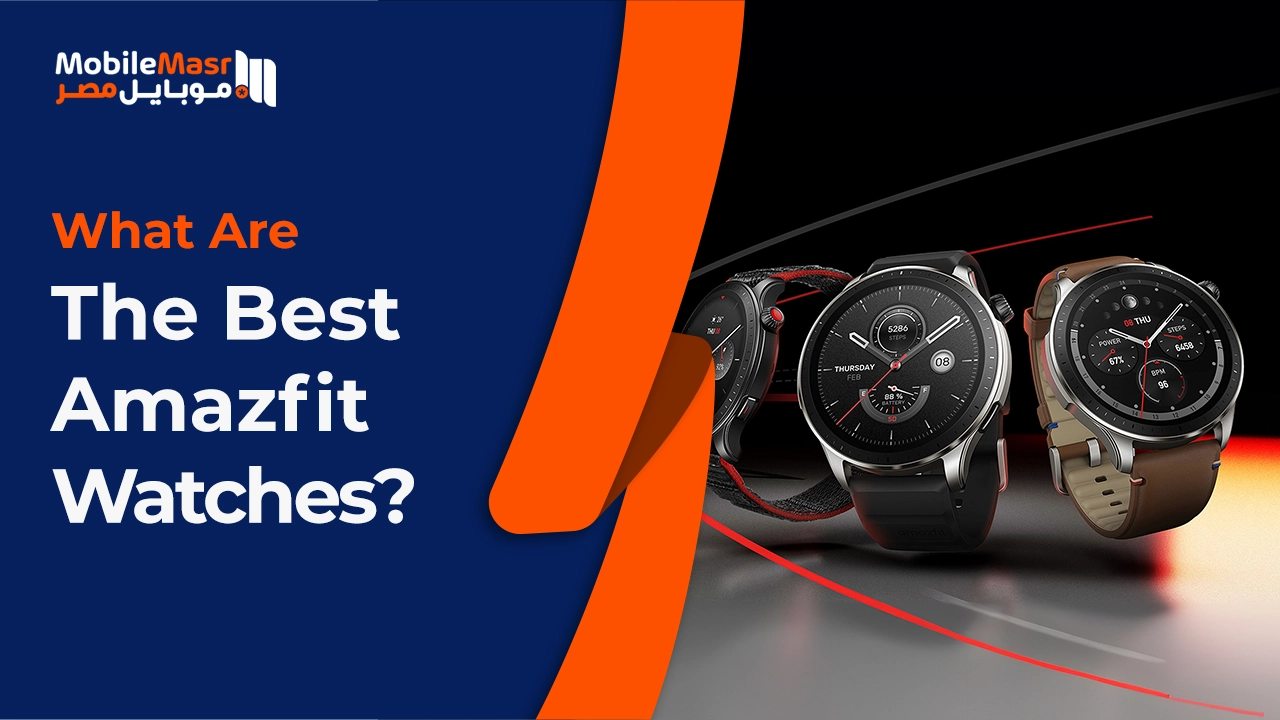
What Are the Best Amazfit Watches in 2026?
Why Are Amazfit Watches So Popular in 2026?
The smartwatch market in 2026 is more competitive than ever, yet Amazfit continues to stand out as one of the most talked-about brands in the wearable tech space. The best Amazfit watches are no longer just budget alternatives — they've become serious contenders that go head-to-head with premium brands in terms of health tracking accuracy, display quality, software refinement, and overall user experience. What's driving this surge in popularity isn't a single feature but rather the consistent delivery of a premium-level experience at a price that doesn't break the bank.
Amazfit smartwatches have earned a devoted global following, particularly in markets like Egypt and the broader Middle East, where consumers are increasingly tech-savvy and demand high value for their money. The brand's ability to pack dual-band GPS, AMOLED displays, multi-week battery life, and advanced health sensors into watches priced between $99 and $400 is genuinely remarkable — and it's why millions of users are choosing Amazfit over more expensive alternatives.
In this guide, we'll break down everything you need to know about the best Amazfit watches of 2026, from the entry-level options all the way to the flagship models, helping you make an informed decision that fits your lifestyle, fitness goals, and budget.
What Makes Amazfit Different From Other Smartwatch Brands?
How Does Amazfit Balance Price and Features?
The core of Amazfit's competitive advantage is a relentless commitment to value engineering. While rival brands often charge a premium for name recognition or ecosystem lock-in, Amazfit — owned and developed by Zepp Health — focuses on delivering the highest possible feature set within each price tier. The result is Amazfit watch specifications that frequently surpass what competitors offer at the same price point.
Take the Amazfit Active Max as a prime example. Launched at CES 2026, it comes with a 1.5-inch AMOLED display reaching 3,000 nits of brightness — matching the output of Apple Watch Ultra 3, which retails at $799. The Active Max is priced at just $169.99. That kind of value proposition is what makes Amazfit watch cost one of the most discussed topics in smartwatch reviews. Alongside this, you get GPS, comprehensive health tracking, Bluetooth calling, and up to 25 days of battery life — features that would typically cost far more with other brands.
Amazfit watch features across the entire lineup include multi-system GPS support, BioTracker sensors for continuous heart rate and SpO2 monitoring, sleep tracking, stress monitoring, water resistance, and Zepp OS — a proprietary operating system optimized for performance and battery efficiency. This combination consistently delivers an experience that punches well above its price class.
Why Do Users Prefer Amazfit for Daily Use?
Daily wearability is where Amazfit truly earns its loyal user base. The Amazfit user experience revolves around three pillars: comfort, clarity, and convenience. Most Amazfit smartwatches are lightweight and slim, making them genuinely comfortable to wear 24/7, including during sleep. The AMOLED displays are bright enough for outdoor use, even in direct sunlight. And the battery life — typically two weeks or more — means you can go days without thinking about charging, which is something few competing brands can claim.
Users who've switched to Amazfit from daily-charge smartwatches consistently report that the freedom of a long-lasting battery changes their relationship with the device entirely. Instead of treating it as a gadget to be managed, they treat it as an always-on health companion. The Zepp app, which serves as the companion platform for all Amazfit smartwatches, provides detailed health and fitness dashboards, watch face customization, app management, and AI-powered coaching features that add genuine value to the daily experience.
How Has Amazfit Evolved Over the Years?
What Key Innovations Did Amazfit Introduce Recently?
Amazfit's journey from a simple fitness band maker in 2015 to a full-fledged smartwatch competitor in 2026 is a story of rapid iteration and smart innovation. In recent years, the company has introduced a series of meaningful upgrades that have elevated its standing in the market. The introduction of dual-band GPS — Amazfit dual-band GPS — was a landmark moment, dramatically improving tracking accuracy in urban environments where tall buildings cause signal interference. Previously, this technology was only found in Garmin and high-end Apple Watch models; Amazfit brought it to the mid-range segment.
The Zepp OS platform has been continuously refined, moving from a basic firmware interface to a proper smartwatch operating system with a mini-app ecosystem, third-party integrations, and AI features like Zepp Coach, which delivers personalized training plans based on your fitness data. The BioCharge energy monitoring system, introduced in 2026 models, combines HRV data, sleep quality, and recovery metrics into a single daily readiness score — a feature that helps users train smarter, not just harder.
The Amazfit Active 3 Premium, announced in early 2026, brought sapphire glass to the under-$170 price category — a material previously reserved for watches costing three to four times as much. These innovations reflect a brand that isn't standing still but actively pushing the boundaries of what affordable smartwatches can deliver.
How Did Amazfit Improve Software and Sensors?
Amazfit health tracking has benefited enormously from sensor upgrades in recent generations. The transition from BioTracker 5.0 to BioTracker 6.0 in the 2026 lineup brought measurable improvements in heart rate accuracy, SpO2 reliability, and stress detection precision. The new sensor uses an upgraded PPG (photoplethysmography) optical system that performs better during high-intensity workouts, where wrist movement can introduce noise into the data.
On the software side, Amazfit sleep tracking received a significant overhaul, now measuring sleep stages — light, deep, and REM — with greater granularity. The Zepp app presents this data in an accessible, actionable format, linking sleep quality to next-day energy levels and workout performance. Regular OTA (over-the-air) firmware updates ensure that even older models benefit from ongoing software improvements, extending the useful life of each device well beyond its initial release.
Why Are Amazfit Watches Ideal for the Egyptian Market?
How Do Amazfit Watches Handle Hot Weather Conditions?
Egypt's climate presents specific challenges for electronic devices and their wearers. With summer temperatures regularly exceeding 40°C and extended periods of intense sunlight, a smartwatch needs to perform reliably under conditions that would render a dim display unreadable or cause a sensitive sensor to malfunction. Amazfit AMOLED display technology addresses this directly — the high brightness levels found in models like the Active Max (3,000 nits) and GTR 4 (2,000 nits) ensure excellent visibility even in harsh outdoor light.
Amazfit water resistance ratings across most models start at 5 ATM, which means the watches can handle heavy sweating, rain, and casual swimming without any concern. For a country where outdoor activities and physical exertion often happen in high-heat environments, this level of durability is not a luxury but a necessity. The lightweight construction of most Amazfit watch designs also means less discomfort when wearing the device in hot weather for extended periods.
Why Are Amazfit Prices Competitive in Egypt?
Amazfit watch cost in Egypt is one of the most compelling reasons for the brand's growing popularity in the local market. At a time when premium smartwatches from global brands can cost anywhere from 20,000 to 50,000 Egyptian pounds, Amazfit mid-range watches offer comparable features at prices starting from approximately 7,000 to 15,000 EGP on major platforms like MobileMasr Entry-level models like the Bip 6 are available even lower, making Amazfit smartwatches accessible to a far wider segment of Egyptian consumers.
The competitive Amazfit watch cost is further supported by the availability of installment payment plans through authorized retailers and online platforms in Egypt, which lowers the upfront barrier to ownership. For Egyptian consumers who want a genuine smartwatch experience — GPS tracking, health monitoring, AMOLED display, and long battery life — without the price premium of competing brands, Amazfit is consistently the most logical choice.
How Can You Choose the Best Amazfit Watch for Your Needs?
Choosing among the best Amazfit watches requires more than just picking the most expensive or most-talked-about model. The right choice depends on understanding your lifestyle, your fitness habits, how you plan to use the watch, and what you're willing to spend. Amazfit smartwatches span a wide range of price points and capabilities, and every tier has its own strengths. Here's how to approach the decision systematically.
What Should You Consider Before Buying an Amazfit Watch?
How Important Is Display Type and Size?
The display is your primary interface with your Amazfit smartwatch, and getting it right makes a significant difference in daily satisfaction. All modern Amazfit watches use AMOLED displays, but they vary in size and brightness. Larger screens — like the 1.5-inch panel on the Active Max or the 1.43-inch display on the GTR 4 — make it easier to read detailed workout data, notifications, and health metrics at a glance. Smaller screens on models like the GTS 4 Mini or Bip 6 are more wrist-friendly and better suited to users with smaller wrists or a preference for a discreet look.
Brightness matters particularly for outdoor use. Amazfit AMOLED display panels in the newer models reach 2,000 to 3,000 nits, which is more than enough for reading data in direct sunlight — a practical necessity in sunny climates like Egypt's. If you spend most of your time indoors or in moderate lighting, a standard-brightness display will serve you perfectly well. But if you're an outdoor runner or cyclist, prioritizing a high-brightness model will pay dividends in usability.
Does Build Quality Matter for Long-Term Use?
Absolutely. Amazfit watch design varies meaningfully across the product lineup, and the materials used directly affect how long the watch will look and function like new. Entry-level models use aluminum frames with tempered glass, which is entirely adequate for everyday use. Mid-range models like the GTR 4 step up to a polished stainless steel frame. Premium models like the Balance 2 and Active 3 Premium use sapphire crystal glass — the hardest watch glass available — which is highly resistant to scratching and surface damage.
For users who lead active lives, work with their hands, or tend to bump their wrists against hard surfaces, investing in a model with sapphire glass and a reinforced frame can prevent the cosmetic degradation that often makes a smartwatch look worn within a year. The T-Rex series takes build quality even further with military-grade construction standards, making it the most resilient Amazfit watch design in the lineup.
How Do Fitness Goals Affect Your Choice?
Which Amazfit Watches Are Best for Casual Fitness?
If your fitness routine consists of daily walks, occasional gym sessions, some light running, and general activity tracking, you don't need the most feature-rich model in the Amazfit lineup. Amazfit sports watches from the Bip, GTS, and standard Active series cover all of these needs comprehensively. These models offer 100+ sport modes, automatic workout detection, calorie tracking, step counting, heart rate monitoring, and sleep tracking — everything a casual fitness user needs, packaged in a lightweight and affordable form.
The Amazfit Active 2, for instance, earned five-star reviews from major tech publications at just $99, with reviewers noting that it feels like a watch from a higher price category. For beginners entering the world of fitness tracking, or users who want health insights without overwhelming complexity, this is where the best Amazfit watches for casual use live.
Which Models Are Designed for Athletes?
Serious athletes need tools that can keep up with serious training. Amazfit sports watches at the performance end of the lineup — including the Active Max, Active 3 Premium, Cheetah Pro, T-Rex Ultra 2, and Balance 2 — are built with athlete-specific features in mind. These include running power metrics, lactate threshold estimation, VO2 Max calculation, adaptive training plans via Zepp Coach, offline maps for trail navigation, and recovery monitoring through HRV and BioCharge scores.
The Amazfit T-Rex Ultra 2, in particular, has been praised by outdoor athletes for its ruggedness and tracking capabilities, including a built-in flashlight — inherited from the T-Rex 3 Pro — that makes it genuinely useful for early morning runs or nighttime trail activities. These aren't just fitness accessories; they're training tools that can meaningfully improve athletic performance when used consistently.
How Does Battery Life Influence the Buying Decision?
Which Amazfit Watches Offer the Longest Battery Life?
Amazfit watch battery life is one of the most frequently cited reasons people choose the brand over competitors. At the top of the battery life rankings sits the Amazfit Active Max with an impressive 25 days of typical use on a single charge. The Balance 2 follows with up to 21 days, while the GTR 4 and Bip 6 deliver around 14 days. Even the entry-level Band 7 manages up to 18 days, making it one of the most battery-efficient devices in its class.
To put this in perspective: many competing smartwatches from major brands require daily or every-other-day charging. The Amazfit watch battery advantage is especially significant for users who travel frequently, who dislike charging routines, or who simply want a device that disappears into the background and just works. In practical terms, a two-week battery means you charge your watch roughly twice a month — a fundamentally different experience than managing a daily charging habit.
How Does Usage Style Affect Battery Performance?
While the advertised battery figures are based on typical use scenarios, real-world performance varies depending on how you use the watch. Enabling continuous GPS during every workout will drain the battery faster than periodic GPS activation. Setting the display to always-on mode significantly reduces battery life compared to raise-to-wake. High screen brightness, frequent heart rate checks every second rather than every 30 seconds, and active Bluetooth connection also contribute to faster battery consumption.
The good news is that Amazfit smartwatches give users granular control over these settings, allowing you to optimize for battery life when needed or for maximum tracking accuracy during key training sessions. A user who activates GPS only during workouts and keeps the display at moderate brightness can often exceed the advertised battery figures.
Which Are the Best Amazfit Watches Series in 2026?
What Are the Best Amazfit GTR Watches in 2026?
How Do GTR Models Differ From Each Other?
The GTR series is Amazfit's flagship round-face lineup, combining classic watch aesthetics with modern smartwatch capabilities. The Amazfit GTR 4 remains one of the most well-rounded models in the series, featuring a 1.43-inch AMOLED display with a polished stainless steel frame, dual-band GPS, 150+ sports modes, Bluetooth calling, built-in microphone, and up to 14 days of battery life. Its glass-ceramic back panel and Zepp OS 2.0 platform position it as a premium daily driver that works equally well in the boardroom and on the running track.
The GTR Mini offers a more compact and lightweight alternative, retaining the round form factor and core health tracking features at a lower price and with a smaller case that suits users with slimmer wrists. The GTR series as a whole is defined by its attention to aesthetics — these are Amazfit watches that look elegant enough to wear in professional or formal settings, unlike the bulkier sports-focused models.
Who Should Choose the Amazfit GTR Series?
The GTR series is ideal for users who want a smartwatch that doesn't scream "fitness tracker" but still delivers serious health and sports tracking capabilities. If you attend professional meetings during the day and head to the gym or go running in the evening, the GTR's round, refined design bridges both worlds seamlessly. It's also a strong recommendation for Amazfit women's watches consideration, as the slimmer GTR Mini variant fits smaller wrists comfortably and offers an elegant profile.
What Are the Best Amazfit GTS Watches in 2026?
Why Is the Square Design Popular Among Users?
The GTS series adopts a square display format that draws visual comparisons to Apple Watch, and for good reason — it's a proven form factor that many users find more modern and fashionable than the traditional round dial. The flat, square face of GTS models lends itself to larger, more readable display areas relative to the watch's overall size, and the slim body makes these among the most wearable Amazfit watches for everyday use.
Amazfit women's watches find some of their best representation in the GTS lineup. The slim, lightweight construction, variety of color options, and fashionable strap choices make GTS models particularly popular among female users who want a smartwatch that complements their style without sacrificing functionality. Amazfit watch design in the GTS series prioritizes aesthetics alongside capability, and the result is a watch that draws compliments as often as it delivers health data.
Which GTS Model Offers the Best Value?
The Amazfit GTS 4 is widely regarded as the best value proposition within the GTS series. It combines a bright AMOLED display, comprehensive health tracking (heart rate, SpO2, sleep, stress), GPS, Bluetooth calling, music storage and playback, and Zepp OS 2.0 with a mini-app ecosystem — all in a thin, fashionable package. For users who prioritize style alongside functionality, the GTS 4 delivers a feature set that justifies its price convincingly.
The GTS 4 Mini is an excellent alternative for those who want a smaller watch or a lower budget entry point, though it sacrifices some features like built-in GPS and Bluetooth calling. In Egypt, the Amazfit GTS 4 is available through major online retailers at prices ranging approximately between 10,000 and 13,000 EGP, making it a strong mid-range option in the local market.
What Are the Best Amazfit Bip Watches in 2026?
Why Is the Amazfit Bip Series Known for Battery Life?
The Bip series has always been Amazfit's champion of battery endurance, and the 2026 generation continues that tradition. The Amazfit Bip 6 features a 1.75-inch AMOLED display — notably large for this series — with Bluetooth calling capability, 5 ATM water resistance, 120+ sports modes, and a battery that reaches up to 14 days on a single charge. The lightweight body and straightforward interface make it one of the most approachable watches in the entire Amazfit lineup.
Amazfit watch battery performance in the Bip series benefits from hardware optimizations that prioritize efficiency over processing power. The result is a watch that tracks your health reliably, handles your notifications, and still has power left at the end of two weeks. For users who've been burned by daily-charge smartwatches from competing brands, the Bip series offers a liberating alternative.
Is the Bip Series Suitable for Beginners?
Unquestionably. The Bip series is the natural entry point for anyone new to Amazfit smartwatches or smartwatches in general. The setup process is simple and quick — download the Zepp app, pair the watch via Bluetooth, enter your personal data, and you're ready to go within minutes. The interface is clean and intuitive, with no steep learning curve, and the core features are clearly presented without overwhelming complexity.
For parents looking to introduce fitness tracking to teenagers, or for older users exploring wearable technology for the first time, the Bip 6 is a particularly strong recommendation. Its affordability, combined with genuine health tracking capability and an approachable Amazfit user experience, makes it the ideal starting point.
What Are the Best Amazfit Active & Balance Watches in 2026?
How Do These Models Focus on Lifestyle and Health?
The Active and Balance series represent Amazfit's most ambitious approach to health-focused smartwatches. The Amazfit Balance 2, launched in early 2026, is a comprehensive upgrade from its predecessor, featuring a larger battery, sapphire glass for durability, a brighter display, a faster chipset, dual speakers, and upgraded sensors. Reviewers from major tech publications gave it four stars, noting its excellent health and fitness tracking capabilities and its positioning as a direct competitor to Garmin Venu 4 and Coros Pace 4.
The Active Max, meanwhile, takes a different approach by emphasizing sheer screen real estate and battery endurance. Its 1.5-inch AMOLED display — with 3,000-nit brightness — combined with a 25-day battery and the full suite of health sensors makes it a remarkably capable daily companion. The BioCharge energy monitoring feature, exclusive to 2026 models, gives users a clear daily readiness score that combines HRV data, sleep quality, and physical recovery metrics into one actionable number.
Amazfit health tracking across both series covers heart rate, SpO2, stress levels, sleep staging, menstrual cycle tracking, and skin temperature monitoring on select models. These aren't shallow implementations but genuinely useful health tools backed by Zepp Health's years of sensor and algorithm development.
Who Are These Watches Designed For?
The Active and Balance series target a broad but defined audience: health-conscious professionals who want more than just step counting, fitness enthusiasts who train regularly but aren't elite athletes, and anyone who believes their watch should actively contribute to their wellbeing rather than just display notifications. These Amazfit smartwatches are designed for people who take their health seriously but still want a watch that looks great and integrates smoothly into daily life.
Which Amazfit Watch Is Best for Fitness and Sports?
Which Amazfit Watches Are Best for Running?
How Accurate Is GPS Tracking on Amazfit Watches?
GPS accuracy has been one of the most scrutinized aspects of Amazfit sports watches, and the 2026 generation delivers a genuinely impressive answer. Models equipped with Amazfit dual-band GPS — which accesses both L1 and L5 GPS frequency bands simultaneously — offer markedly improved accuracy in urban environments, where tall buildings and overpasses typically cause signal multipath errors. This technology, previously found only in premium sports watches from Garmin and Polar, is now available across Amazfit's mid-range lineup.
Even models without dual-band GPS, such as the Active 3 Premium, have received hardware attention in 2026. A circularly polarized antenna design in newer models reduces signal reflection and multipath interference, improving positional accuracy in challenging environments. Support for six satellite positioning systems — GPS, GLONASS, BeiDou, Galileo, QZSS, and NavIC — ensures strong signal acquisition in varied geographic locations.
Which Models Support Advanced Running Metrics?
For runners who want more than pace and distance, several Amazfit sports watches deliver a comprehensive suite of running analytics. The Active Max, Active 3 Premium, and Cheetah Pro support running power measurement, lactate threshold estimation, ground contact time, vertical oscillation, cadence, and VO2 Max calculation. The Zepp Coach AI uses these metrics to build adaptive training plans that evolve with your fitness level, providing weekly structure and recovery guidance.
The Active 3 Premium specifically targets beginner-to-intermediate runners with offline maps, turn-by-turn navigation, and BioCharge readiness scoring — making it the best all-round training companion for runners who are building their performance systematically. Its price point under $170 makes it one of the most aggressive value plays in the running watch segment of 2026.
Which Amazfit Watches Are Best for Gym and Strength Training?
How Do Amazfit Watches Track Calories and Reps?
Amazfit health tracking during gym workouts relies on a combination of optical heart rate data, accelerometer readings, and personalized biometric inputs. Calorie estimates are calculated using your heart rate during exercise, your weight and age, and the intensity of the activity detected by the six-axis accelerometer. This approach delivers calorie estimates that are generally considered reliable for moderate to high-intensity gym sessions.
For strength training, select Amazfit smartwatches can detect and count repetitions automatically using the accelerometer, tracking sets, reps, and rest time between exercises. While this feature is less sophisticated than dedicated gym tracking apps, it provides a useful at-a-glance overview of your session without requiring manual logging. The watch's ability to simultaneously track heart rate zones during strength work gives you insight into cardiovascular effort that many gym users find surprisingly informative.
Which Sensors Matter Most for Gym Users?
For gym users, the BioTracker 6.0 sensor is the most important component — it ensures accurate heart rate data even during exercises with significant wrist movement, like rowing or kettlebell work, where earlier-generation sensors often struggled. The six-axis accelerometer is the second key sensor, responsible for rep counting and activity detection. A bright AMOLED display also matters in gym environments, where the watch is frequently consulted between sets.
Amazfit watch specifications in mid-range and premium models include all of these components, making the GTR 4, Active Max, and Balance 2 strong recommendations for gym-focused users.
Which Amazfit Watches Are Best for Swimming and Outdoor Sports?
What Water Resistance Ratings Do Amazfit Watches Offer?
Amazfit water resistance varies across the lineup but is consistently solid. The majority of Amazfit sports watches carry a 5 ATM water resistance rating, which translates to protection at depths up to 50 meters for 10 minutes under static conditions — sufficient for recreational swimming, showering, and sweating in wet conditions. This rating means you never need to remove your watch during normal water exposure, which is a genuine convenience for daily life.
The T-Rex series pushes further, with the T-Rex Ultra 2 rated at 10 ATM — suitable for snorkeling and more demanding water sports. The broader T-Rex lineup also carries military-grade certifications for resistance to dust, extreme temperatures, salt water, and shock, making it the definitive Amazfit sports watch for users who operate in harsh conditions regularly.
Which Models Support Open Water Swimming?
For dedicated swimmers, the Balance 2, Active Max, and T-Rex Ultra 2 offer the most complete open water swimming experience. These models track swim strokes, lap counts, SWOLF efficiency scores, and heart rate in water. The optical heart rate sensors in these models are configured to function underwater, providing continuous cardiovascular monitoring throughout your swim session. For pool swimmers, automatic lap detection handles session structure without any manual input.
Which Amazfit Watch Is Best for Health Tracking?
How Accurate Is Heart Rate Monitoring on Amazfit Watches?
How Do Amazfit Sensors Compare to Competitors?
Amazfit health tracking through optical heart rate monitoring has matured considerably. The BioTracker 6.0 sensor found in 2026 flagship models delivers accuracy that competes well against sensors in watches costing significantly more. In resting conditions and low-intensity activities, heart rate readings from Amazfit smartwatches align closely with chest strap measurements — considered the gold standard. During moderate exercise, accuracy remains high. During very high-intensity, high-impact activities, minor discrepancies can occur, as is standard across all optical heart rate sensors.
Compared to similarly priced Garmin, Fitbit, and Huawei models, Amazfit sensors perform comparably or better in most use scenarios. The key advantage is that Amazfit continues to improve these sensors across generations without dramatically increasing price, meaning each new model generation genuinely delivers better accuracy than its predecessor.
When Is Heart Rate Data Most Reliable?
Heart rate data from Amazfit smartwatches is most reliable when the watch is worn correctly — snug against the wrist, positioned about two finger-widths above the wrist bone. Data accuracy is highest during consistent-pace activities like running, cycling, and swimming. It's somewhat less precise during interval training or exercises with significant wrist movement. For sleep monitoring, where the body is largely stationary, Amazfit heart rate data is highly reliable and provides excellent input for sleep stage analysis and HRV calculation.
How Do Amazfit Watches Track Sleep Quality?
What Sleep Metrics Do Amazfit Watches Measure?
Amazfit sleep tracking is among the most detailed in the mid-range smartwatch category. The watches measure total sleep duration, sleep efficiency, time to fall asleep, sleep stage breakdown (light, deep, and REM), nighttime heart rate trends, and overnight SpO2 levels. The SpO2 monitoring component is particularly valuable as it can detect potential signs of sleep apnea — periods where oxygen levels drop significantly during sleep — and flag them for medical follow-up.
The BioCharge system in 2026 models takes sleep data a step further by combining it with HRV and physical activity recovery metrics to produce a morning readiness score. This score tells you, in practical terms, how recovered your body is and how intensely you should train — or whether rest is the smarter choice. It's a level of insight that was previously only available in dedicated recovery monitors costing several times as much.
How Can Users Benefit From Sleep Insights?
The practical value of Amazfit sleep tracking lies in pattern recognition over time. After wearing your watch consistently for a few weeks, the Zepp app builds a picture of your sleep patterns — your average bedtime, your typical sleep duration, your proportion of deep versus light sleep, and how these correlate with your next-day energy levels and workout performance. This long-term perspective helps identify behaviors that consistently hurt or help your sleep quality, like screen time habits, late-night eating, or exercise timing.
For users with demanding schedules, the readiness score and sleep insights become a data-driven argument for prioritizing rest — something that's easy to rationalize away without objective feedback. Many Amazfit user experience testimonials specifically mention sleep tracking as one of the features that delivers the most ongoing value.
How Effective Is SpO2 and Stress Monitoring?
Which Models Offer Continuous SpO2 Tracking?
Continuous SpO2 monitoring — measured throughout the day and automatically during sleep — is available on most mid-range and premium Amazfit smartwatches, including the GTR 4, GTS 4, Balance 2, Active Max, and T-Rex Ultra 2. The automatic nighttime SpO2 tracking is particularly useful, as blood oxygen levels can fluctuate meaningfully during sleep without the wearer being aware of it.
For users at altitude, those with respiratory conditions, or those who engage in endurance sports at varied elevations, regular SpO2 monitoring provides meaningful health data. The watch will alert you if readings fall below a user-configurable threshold, prompting you to take action or consult a healthcare provider.
How Useful Is Stress Monitoring in Daily Life?
Amazfit stress monitoring uses heart rate variability (HRV) analysis to estimate physiological stress levels in real time. The watch displays stress as a score on a scale, and the Zepp app tracks how this score evolves throughout the day and over time. When stress levels are high, the watch can prompt you to take a guided breathing exercise, which has been shown to activate the parasympathetic nervous system and reduce acute stress responses.
In practical daily life, the stress monitoring feature serves as a useful prompt to pause, breathe, and recover — particularly valuable in high-pressure work environments. While it's not a clinical diagnostic tool, the long-term trends it reveals can be genuinely insightful, helping users identify the times of day, activities, or situations that consistently elevate their stress levels.
How Does Amazfit Software and Zepp OS Perform in 2026?
What Is Zepp OS and How Does It Work?
How User-Friendly Is the Zepp OS Interface?
Zepp OS is Amazfit's proprietary smartwatch operating system, developed internally to maximize performance and battery efficiency on Amazfit hardware. Unlike general-purpose operating systems like Wear OS or watchOS, Zepp OS is purpose-built for smartwatch interactions — fast wake times, smooth swipe navigation, and minimal resource consumption that contributes directly to long battery life.
The interface is organized around swipeable panels: a central watch face, a left-swipe for health stats, a right-swipe for Shortcut Cards (a customizable panel of your most-used data like steps, heart rate, weather, and calendar), and an upward swipe for the app list. The learning curve is minimal, and most users are fully comfortable with the interface within a day of use. The Amazfit user experience on Zepp OS is clean and purposeful — not cluttered with features you'll never use, but rich enough to satisfy power users who want detailed data access.
How Often Does Amazfit Release Updates?
Amazfit releases firmware updates on a rolling schedule, typically monthly for newer models and every few months for older ones. These updates arrive wirelessly via the Zepp app and install automatically when the watch is charging, ensuring minimal disruption. Updates frequently include new features — new sport modes, refined health algorithms, new watch face templates, and performance improvements — rather than just bug fixes. Models from 2023 onward continue to receive meaningful updates in 2026, reflecting Amazfit's commitment to software longevity.
Which Smart Features Do Amazfit Watches Offer?
Do Amazfit Watches Support Notifications and Calls?
Yes — Amazfit smartwatches in the mid-range and premium tiers support full notification mirroring from your smartphone. Messages, emails, calls, social media notifications, and app alerts appear on your watch with customizable vibration patterns. On models with a built-in microphone and speaker — including the GTR 4, Bip 6, T-Rex 3 Pro, and Active Max — you can answer and conduct phone calls directly from the watch via Bluetooth, keeping your phone in your pocket.
The call quality on Amazfit's Bluetooth call-capable models is notably good for the category, with users and reviewers consistently noting the microphone clarity as a genuine selling point. This is one of the Amazfit watch features that adds tangible daily convenience, particularly while exercising, driving, or working with your hands.
Can You Control Music and Apps From the Watch?
Yes. All Amazfit smartwatches with Zepp OS include a music control panel that lets you play, pause, skip, and adjust volume for music playing on your paired smartphone. On select models with internal storage — including the Balance 2 and some Active variants — you can store music directly on the watch and play it wirelessly through Bluetooth earbuds, making your phone entirely optional during workouts.
The Zepp OS mini-app ecosystem includes applications for weather, calendar, alarm, timer, stopwatch, navigation, and third-party integrations. While the app library is smaller than what Wear OS or watchOS offer, it covers the essentials comprehensively, and the curated nature of the ecosystem means each available app is well-integrated with the watch's interface and battery management.
How Compatible Are Amazfit Watches With Android and iOS?
Are There Any Limitations for iPhone Users?
Amazfit watches work with iPhones through the Zepp app, which is available on iOS. Core features — health tracking, sleep monitoring, notifications, GPS workouts, and fitness data sync — all function properly on iOS. However, some features are more limited on iPhone compared to Android. Bluetooth calling, for example, may not work as seamlessly on iOS due to Apple's stricter Bluetooth API restrictions. Similarly, some notification replies and app-specific integrations may be unavailable on iPhone.
Despite these limitations, the Amazfit user experience on iPhone covers 80-90% of the functionality available on Android, and for most users, the health tracking, GPS, and battery life advantages of Amazfit smartwatches outweigh the iOS-specific trade-offs. Amazfit has historically been more Android-focused but has steadily improved its iOS integration with each software update.
How Smooth Is Integration With Android Phones?
On Android, Amazfit smartwatches deliver their fullest experience. The Zepp app on Android provides complete feature access, including fast notification delivery, Bluetooth call support, seamless app data sync, and compatibility with Android 7.0 and above — covering virtually the entire active Android device base. Integration with popular fitness platforms like Strava, Google Fit, and Apple Health (on iOS) allows your Amazfit data to feed into broader health ecosystems you may already be using.
The overall Amazfit user experience on Android is consistently smooth, with pairing taking less than a minute and data syncing happening automatically in the background throughout the day.
What Are the Best Amazfit Watches by Budget in Egypt?
What Are the Best Budget Amazfit Watches in 2026?
Which Models Offer the Lowest Price?
At the entry level of Amazfit's lineup, the Band 7 and Bip series offer the most affordable access to genuine Amazfit smartwatch functionality. The Band 7 starts at approximately $60 globally, while Bip models range from $70 to $100. In Egypt, these models are typically available on MobileMasr in a range starting from approximately 5,000 to 8,000 EGP depending on the retailer, exchange rate fluctuations, and any promotional offers in effect at time of purchase.
These budget Amazfit mid-range watches deliver solid step counting, heart rate monitoring, sleep tracking, and notification mirroring. The Band 7 includes up to 18 days of battery life and basic SpO2 monitoring. For first-time smartwatch buyers or users with tight budgets, these models represent excellent starter Amazfit smartwatches that deliver real daily value.
What Features Are Missing in Budget Models?
Budget Amazfit models typically lack standalone GPS (relying on the smartphone's GPS for route tracking), AMOLED displays in some cases, Bluetooth calling capability, and the advanced health metrics like continuous SpO2 tracking, HRV monitoring, or BioCharge readiness scoring found in higher-tier models. The sport mode selection may also be more limited. If these features matter to you, it's worth stretching to the mid-range tier.
What Are the Best Mid-Range Amazfit Watches in Egypt?
Which Models Offer the Best Balance of Price and Performance?
The mid-range segment — Amazfit watches cost between $100 and $200, or roughly 8,500 to 17,000 EGP in Egypt — is where Amazfit truly excels and where the best value proposition lives. Models like the Amazfit Active 2 ($99), GTR 4 (~11,000 EGP), GTS 4, and Active Max ($169.99) dominate this space and consistently receive the highest praise in Amazfit watch comparison and review articles.
These watches include built-in GPS, AMOLED displays, comprehensive health tracking, Bluetooth calling, sports mode libraries exceeding 120 options, and battery lives ranging from 10 to 25 days. Amazfit mid-range watches deliver features that, just two or three years ago, would have cost twice as much. For the Egyptian consumer, this price tier represents an exceptional entry into serious smartwatch ownership.
Who Should Choose Mid-Range Amazfit Watches?
Mid-range Amazfit smartwatches are the right choice for the widest range of users: office workers who track their daily activity and want health alerts, casual runners and gym-goers who want GPS tracking and workout analysis, health-conscious individuals monitoring heart rate and sleep, and anyone who wants a smartwatch that looks good and works reliably for 1-2 years without needing an upgrade. This is the segment where the Amazfit watch review consensus is most uniformly positive.
What Are the Best Premium Amazfit Watches in 2026?
What Extra Features Do Premium Models Offer?
Premium Amazfit watches — the T-Rex Ultra 2, Balance 2, Falcon, and Active 3 Premium — command prices between $250 and $400 globally (approximately 21,000 to 34,000 EGP in Egypt). In exchange, they deliver features that justify the premium: sapphire crystal glass, titanium or premium aluminum frames, larger internal storage (up to 4GB) for maps and music, Amazfit dual-band GPS for maximum tracking accuracy, dual speakers, and more advanced health algorithms.
The Balance 2 in particular stands out for its sapphire glass, 21-day battery, and superior sensor suite. The T-Rex Ultra 2 appeals to adventure sports enthusiasts with its military-grade durability, 10 ATM water resistance, built-in flashlight, and offline navigation. These are Amazfit sports watches built to perform in conditions that would challenge any consumer device.
Are Premium Amazfit Watches Worth the Price?
For users who genuinely utilize the advanced features, yes. An outdoor runner who values GPS accuracy, a hiker who needs offline maps, or a professional who wants a durable watch that performs at the gym and looks appropriate at a business meeting — these users will find the premium tier a worthwhile investment. However, for users who primarily want health tracking and notification management, the mid-range tier delivers 90% of the experience at half the price. The Amazfit watch comparison between mid-range and premium models really comes down to how intensively you'll use the advanced capabilities.
How Much Do Amazfit Watches Cost in Egypt in 2026?
What Factors Affect Amazfit Watch Prices in Egypt?
How Do Exchange Rates Impact Pricing?
Amazfit watch cost in Egypt is directly tied to the USD/EGP exchange rate, as these are imported products priced in US dollars at the global level. When the Egyptian pound weakens against the dollar, local prices rise proportionally. This means that Amazfit watch prices on Egyptian platforms can vary month to month based on currency fluctuations, which is worth monitoring if you're planning a purchase and can time it around more favorable exchange rates.
As of early 2026, approximate price ranges in Egypt are as follows based on available data from platforms like MobileMasr, and local authorized retailers:
- Entry-level (Band 7, Bip series): 5,000 – 8,000 EGP
- Mid-range (Active 2, GTS 4, GTR 4): 8,500 – 15,000 EGP
- Upper mid-range (Active Max, Balance 2): 15,000 – 22,000 EGP
- Premium (T-Rex Ultra 2, Falcon): 22,000 – 34,000 EGP
For the most current and accurate pricing, it is recommended to check directly with authorized retailers or contact Mobile Masr customer service through mobilemasr.com, as prices shift frequently with exchange rate movements and promotional cycles.
Does Warranty Affect the Final Price?
Yes, warranty status meaningfully affects pricing in Egypt. Products sold through authorized distributors with an official one-year warranty are priced higher than grey-market imports without warranty coverage. While grey-market units may appear cheaper upfront, the lack of after-sales support can result in significant costs if the watch develops a fault. For a device worn daily and exposed to physical activity, sweat, and general wear, investing in an officially warranted unit is the smarter long-term decision.
Where Can You Find the Best Deals on Amazfit Watches?
Are Online Stores Cheaper Than Physical Shops?
In most cases, yes. Online platforms including MobileMasr typically offer lower prices on Amazfit smartwatches than physical retail stores, primarily because their operating costs are lower and they can pass those savings to the consumer. These platforms also allow you to compare multiple sellers simultaneously, read user reviews, and take advantage of platform-wide promotional events.
Physical stores, on the other hand, allow you to handle the watch before purchasing, which some buyers find valuable for assessing build quality, strap comfort, and display quality in person. For price-sensitive buyers who already know which model they want, online is generally the better channel. For first-time Amazfit buyers who are undecided between models, visiting a physical store to compare options can be worthwhile.
When Is the Best Time to Buy Amazfit Watches?
The best windows for purchasing Amazfit smartwatches at discounted prices in Egypt include major online sales events such as Black Friday, end-of-year clearance periods, Ramadan sales, and platform anniversary events on MobileMasr. Additionally, when a new model is announced — for example, when the Active Max was launched — existing models like the Active 2 typically see price reductions as retailers clear inventory. Monitoring these cycles and being ready to act during promotional windows can yield savings of 15-30% on the listed price.
What Are the Pros and Cons of Amazfit Watches?
What Are the Main Advantages of Amazfit Watches?
Why Is Battery Life a Major Strength?
Amazfit watch battery performance is, without question, the single most compelling reason many users choose the brand. The ability to go two weeks — or in some cases three or four weeks — between charges is a practical luxury that reshapes how you interact with your smartwatch. There's no morning ritual of checking charge levels before heading out, no mid-day anxiety about running low during a workout, and no nightly charging obligation. For users who've previously dealt with the daily charging demands of other smartwatches, the Amazfit battery experience feels genuinely liberating.
This advantage is not accidental — it's the result of a deliberate engineering philosophy at Zepp Health that prioritizes battery efficiency as a core product value. The Zepp OS operating system is specifically optimized to minimize background power consumption while keeping all sensors active, which is why Amazfit smartwatches consistently outlast competitors in the same price and feature tier.
How Does Amazfit Offer Value for Money?
The Amazfit watch cost-to-feature ratio is consistently one of the best in the industry, and this is reflected in virtually every Amazfit watch review from independent tech publications. Whether you're comparing the $99 Active 2 to similarly-priced competitors or the $170 Active Max to watches costing $400 or more, Amazfit consistently delivers more measurable features — display quality, GPS accuracy, health sensors, build quality — per dollar spent.
Amazfit watch features that were exclusive to premium segments just a few years ago — dual-band GPS, sapphire glass, AI coaching, multi-week battery, AMOLED displays — are now available at mid-range price points. For the consumer in Egypt or anywhere else looking to maximize the value of their smartwatch investment, Amazfit watch specifications consistently over-deliver relative to Amazfit watch cost.
What Are the Main Disadvantages of Amazfit Watches?
Where Do Amazfit Watches Fall Short?
Amazfit watch disadvantages are real and worth understanding before making a purchase. The most significant limitation is the Zepp OS app ecosystem. Unlike Wear OS or watchOS, Zepp OS does not support popular third-party apps like Spotify, Strava (direct app, not just data sync), Google Maps, or contactless payments via Google Pay/Apple Pay in many regions. If app extensibility and ecosystem richness are important to you, this is a meaningful constraint.
Amazfit watch disadvantages also include more limited smartwatch functionality compared to Samsung Galaxy Watch or Apple Watch — features like fall detection, crash detection, ECG (electrocardiogram) monitoring, and irregular heart rhythm notifications are absent or limited in Amazfit's lineup. For users with specific medical monitoring needs or those who heavily rely on third-party watch apps, these gaps matter.
Which Users Might Not Prefer Amazfit?
Users who are deeply embedded in the Apple or Google ecosystems and rely on tight watch-phone integration will likely find Amazfit's cross-platform approach less satisfying. Those who use their smartwatch as a primary productivity tool — responding to messages, using apps, managing workflows — may feel limited by Zepp OS compared to more open platforms. And users with specific medical monitoring requirements, such as ECG, will need to look at brands that offer those clinical-grade features. These are the scenarios where Amazfit watch disadvantages outweigh its considerable strengths.
Who Should Buy an Amazfit Watch in 2026?
Are Amazfit Watches Suitable for Beginners?
Which Models Are Easiest to Use?
For beginners, the Amazfit smartwatch lineup offers several excellent starting points. The Bip 6 is the most straightforward — simple interface, long battery life, clear health metrics, and a price that doesn't require significant commitment. The GTS 4 Mini is another strong option for beginners who want a fashionable watch with slightly more capability. The Active 2 sits at the sweet spot of simplicity and feature richness, making it arguably the best all-around beginner Amazfit smartwatch in 2026.
All of these models share a consistent Amazfit user experience framework: easy Zepp app pairing, guided setup, clear daily health summaries, and automatic workout detection that eliminates the need to manually start and stop tracking sessions. For someone new to wearable health technology, these features combine to create a low-friction entry that encourages consistent daily wear — which is ultimately the foundation of any useful health tracking.
How Simple Is the Setup Process?
Setting up an Amazfit smartwatch is genuinely simple. Download the Zepp app from the App Store or Google Play, create an account, tap "Add Device," select your watch model, and follow the pairing instructions. The entire process typically takes under five minutes. Once paired, the app walks you through entering your personal health profile — height, weight, age, gender, fitness goals — which calibrates the watch's tracking algorithms for your specific profile. Software updates, if available, are prompted automatically and install over Wi-Fi or Bluetooth while charging.
This ease of setup is one of the frequently praised aspects of the Amazfit user experience and contributes directly to the brand's appeal in markets where tech confidence varies across the user base.
Are Amazfit Watches Good for Professionals and Athletes?
Which Models Offer Advanced Tracking?
For professionals who prioritize performance data and athletes who train seriously, the upper tier of Amazfit sports watches delivers genuinely advanced capabilities. The Active Max, Active 3 Premium, Cheetah Pro, and T-Rex Ultra 2 are the flagship options, each offering a combination of advanced GPS, training analytics, AI coaching via Zepp Coach, recovery monitoring, and in some cases offline maps and navigation.
Zepp Coach, in particular, is a standout feature for athletes — it analyzes your recent training load, fitness metrics, and recovery data to recommend daily workout intensity, rest days, and race-readiness timelines. This level of AI-driven training guidance was previously associated with dedicated sports platforms costing much more. The inclusion of running power and lactate threshold estimation in 2026 Amazfit sports watches completes a picture of genuinely professional-grade training tools at accessible prices.
Can Athletes Rely on Amazfit Data?
For most athletic purposes, yes. Amazfit watch specifications in the performance tier are reliable enough for training management, progress tracking, and race preparation. Heart rate data, GPS tracking, and sleep monitoring are all sufficiently accurate to make informed training decisions. Elite athletes competing at the highest levels may want cross-reference with chest straps or foot pods for absolute precision, but for the vast majority of dedicated recreational athletes and fitness-focused professionals, Amazfit data is accurate and actionable.
Multiple reviews from athletes who've directly compared Amazfit sports watches to Garmin devices note that while Garmin retains an edge in certain niche areas, the gap has narrowed dramatically in 2026. For the price difference, many athletes find that the best Amazfit watches deliver 90-95% of the value at 40-60% of the cost.
Whether you're stepping into the smartwatch world for the first time or upgrading from an older device, the best Amazfit watches in 2026 offer a compelling package that's hard to match at any price tier. From the entry-level Bip 6 with its two-week battery and clean interface, to the feature-packed Active Max with its 25-day battery and 3,000-nit AMOLED display, to the premium Balance 2 with sapphire glass and AI coaching — there is an Amazfit smartwatch for every lifestyle, every fitness level, and every budget.
The brand's consistent delivery of Amazfit watch features that exceed expectations at each price point, combined with ongoing software support and genuine Amazfit health tracking capability, makes it one of the smartest wearable investments you can make today — especially in the Egyptian market where value for money is a primary consideration.
Ready to find your perfect Amazfit smartwatch at the best price in Egypt? Visit mobilemasr.com now — your trusted destination for new and pre-owned smartphones and smart devices in Egypt. Browse the latest deals, compare models, and get expert advice from the Mobile Masr team today!
FAQs
CONTACT US
©2026 MobiTech Integrated Solutions. . All Rights Reserved